ST. CHARLES COUNTY HISTORY

By Dorris Keeven-Franke

  • The people on the hill

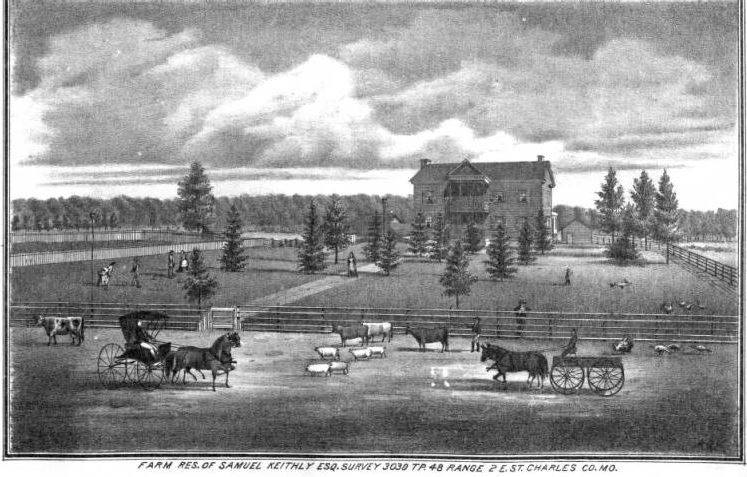
    The Keithly farm directly adjoined land purchased by German emigrant Arnold Krekel to the northwest, of 320 acres, where the town of O’Fallon was founded in 1856. Arnold’s brother Nicholas Krekel would become the O’Fallon Station’s first postmaster and Station Agent when the North Missouri Railroad came through in the 1850s.  But Keithley had been there for many years before, since the 1830s, and his land was further east. And on his land was a road that led from his plantation house up into town to the Railroad tracks, just east of the station. On that road, his enslaved had lived for generations, which was how it had earned its name. The 1930 Census taker would refer to it in a derogitory manner, but for the sake of our younger readers, I will just call it “the hill”. Today, we call it Sonderen avenue.

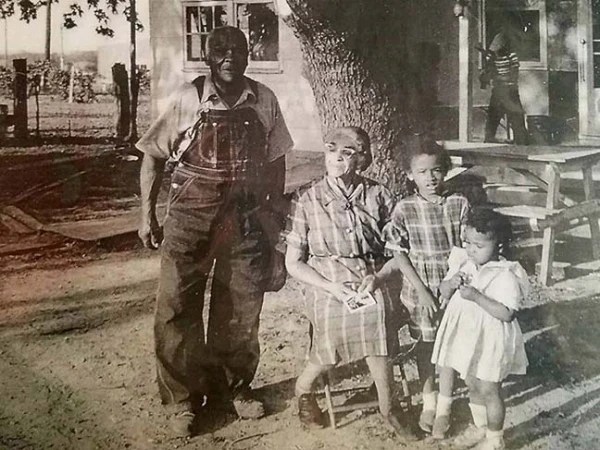
    Simon and Cora (Abington) White and their grandchildren

    Sage Chapel Cemetery sits on an adjoining hill to the south, that the pall bearers coming from the three black churches would have to climb for each funeral. Going home, they would descend and then climb up “the hill” as they headed back to town. (One has to take today’s Interstate 70 out of the picture.) The first home they would pass would be that of Simon White, on the west (left) side of the road. Tucked back out of site, the house had been built in the early 1900s, and the high schoolers would catch the old rickety bus to St. Charles called Franklin School to be able to get their education. His wife Cora was born an Abington.

    Across the road from Simon and Cora, was Liberty Abington, who lived next door to the Sage Chapel Church. He had purchased that quarter acre from the Church’s trustees in 1881. The Abington family had been brought to Missouri back in 1837, enslaved by Henry Abington, who settled just south of Snow Hill, today’s Foristell. Nathan Abington who was only six years old when they came, was one of the early burials at Smith Chapel Cemetery, when he died in 1899. There are also Abington family buried at Grant Chapel Cemetery in Wentzville. (no longer standing)

    After passing Liberty’s house you came to Wishwell Baptist Church, which was right along the creek bottom where they would hold revivals and baptisms along with their services. The earliest black Baptist Church in St. Charles County is Hopewell, and was where they were former members. Hopewell Baptist Church had been started over on the Boone’s Lick Road back before the Civil War. This was a very old church. (no longer standing)

    As you climbed the hill, on the west (left) side, you passed the black school house that the members of community had built. Education was segregated back then, and very few communities had schoolhouses that were attended by both the black and white children together. This was only the early grades for the area’s children in the 1800s.

    In the back is the corner of the Black school to the left, and then Cravens Methodist Church to the right. The children are of the Obrecht family, for which we are indebted for the picture.

    Right next to the schoolhouse was the Cravens Methodist Church South (no longer standing) which originally allowed the enslaved to sit in the gallery to attend. Later, the white community would build another Methodist Church south of town, and the black people would start using this church building. Since Sage Chapel was not being used, it would fall into disrepair. All three churches, Sage Chapel, Wishwell, and Cravens would use what we call Sage Chapel Cemetery to bury in. And for a brief period, at the turn of the century a dispute led to Wishwell and Cravens purchasing an acre of land across town and creating a cemetery named Union Cemetery. However it was short lived, and everyone returned to using what we call Sage Chapel by 1910.

    Across the street on the east side sits a large two story house, that was being used by the black Oddfellows at nearly the same time. When the house was later sold, the buyer was informed that the Oddfellows would still hold title, and their meetings for two more years. The family who were purchasing it, were living down the street, and that was fine.

    I’m sure this tour of the hill is not complete, as there were others who lived on the hill… the Edwards, Williams, Lucketts, Claiborne, Oday, Griffen, Hubbard and Stuart. This is a story of a community, all born in Missouri. From the 78-year-old Judge Williams, who had been born enslaved back in 1850, and his son Thomas’ house was where Pearl Hubbard, the school teacher boarded, down to 9 year old Nellie Luckett, just past the Thomas Luckett house, all according to the 1930 Census. These were the people who lived on the hill.

    For more stories about St. Charles County subscribe (for free) to stcharlescountyhistory.org

    Or you can follow us on Facebook

  • Sage Chapel A.M.E. Church

    How it came to be called Sage…At the time that the Trustees purchased the one-acre parcel of ground known as Sage Chapel Cemetery in 1881, a travelling preacher named Jefferson Franklin Sage was ministering between St. Charles and Jonesburg, Missouri.[1] That purchase include a half acre of ground on what was often referred to as “the hill” in O’Fallon [today’s Sonderen Avenue] which they would divide into two lots. One, a quarter acre lot would be purchased by Liberty Abington which would pay off the purchase for both the cemetery and the Sonderen Avenue property. On the other half, the Trustees would build a small African American chapel, which they would name Sage Chapel, probably because the first traveling minister that would preach here was named Jefferson Franklin Sage.

    Members of the St. Charles African American community met with members of the African Methodist Episcopal Conference in St. Louis Conference on October 18, 1865, and subsequently founded the St. Charles Conference, which included the St. John’s AME in St. Charles, then Sage Chapel on what is today’s Sonderen, then Grant Chapel AME in Wentzville and finally Smith Chapel AME in Foristell. All of these would first be served by traveling ministers. (From the Church Records of St. John AME). The only ones still standing are St. Johns on Washington in St. Charles, and Grant Chapel in Wentzville.

    Twenty two-year old Pastor Sage was living in Jonesburg in 1876 with his wife Liza and 2 small sons John and Dick. He lost his wife and one son before 1878. He remarried in 1879 and moved to St. Charles in 1880[2]. He and his second wife Mary, have a new son James, and he works as a clerk at the American Car Foundry when living in St. Charles in 1880. Pastor Jefferson Franklin Sage is found throughout the records of St. John’s African Methodist Episcopal at their Quarterly Conference, beginning in 1878, and the records noted as Grant Chapel[3], another African Methodist Episcopal Church in Wentzville( already established). He is recorded as a Jonesburg minister, and indicated as traveling between Jonesburg and St. Charles. No church records for Sage Chapel African Methodist Church have been located yet, which tell us how the name of Sage Chapel Cemetery relates to “Local Preacher Jefferson Sage”.  However, he was apparently well loved by the black community as he continued to serve in that capacity for many years. By 1894, J.F. Sage is serving a new congregation as a minister in Kansas. He would later be called to Lexington, Missouri, where he died in 1922.  


    [1] Records of the Conferences of the African Methodist Church, Records located in the St. Charles County Historical Society, 101 S. Main Street, St. Charles, MO 63301

    [2] 1880 Census, Saint Charles, St Charles, Missouri; Roll: 714; Family History Film: 1254714; Page: 72A; Enumeration District: 201

    [3] Records located in the St. Charles County Historical Society, 101 S. Main Street, St. Charles, MO 63301

    WANT A DAILY DOSE OF ST CHARLES COUNTY HISTORY? SUBSCRIBE BY EMAIL AND YOU DON’T HAVE TO CATCH ME ON FACEBOOK.

  • How Sage Chapel Cemetery began…

    In the early 1800s, Samuel Keithly (1789-1870) came from Kentucky, and settled in St. Charles County, bringing his enslaved. The father of a large family with seven children, several step-children, and many grandchildren, the family had other members who owned slaves as well. By the 1840s, the family owned hundreds of acres of land, and had purchased  land near today’s O’Fallon, Missouri where Sage Chapel Cemetery lies. Keithly was one of the largest slave owners in St. Charles County according to the U.S. Slave Schedules of 1850 and 1860. Among those who he enslaved were John Rafferty and his sisters Ludy, Elsie and Lizzie according to Mary Stephenson.

    Samuel Keithly didn’t free any of his enslaved. Some histories state that he gave the land that we call Sage Chapel Cemetery to his slaves, where they worshiped in a field of Sage. What we do know was that among Samuel Keithly’s slaves was John Rafferty. According to Mary Stephenson, who is his descendant, John Rafferty and his sisters, Frances, Ludy, Elsie, and Lizzie had been born in Kentucky, and brought to Missouri.

    When John Rafferty (Senior) passed away in 1881, his former enslaver Samuel Keithly (Senior) had already passed away as well. But burials had already been taking place on the former Keithly plantation, on the same land that had been inherited and was by then owned by his daughter  Mahala Keithly Castlio (1817-1896) and her husband Jasper N. Castlio. This was the same land that the enslaved people had been burying on for generations before. And they wanted to keep burying in the same graveyard.

    So in 1881, Samuel Kiethly’s daughter Mahala and her husband Jasper Castlio legally transferred  property that included a small church building of the African Methodist Episcopal Church on “the hill” [today’s Sonderen Avenue] and the cemetery which lay at its southern terminus  to three A.M.E. Trustees. On August 20th, in 1881, Mahala and her husband Jasper, transferred to three Trustees of the African Methodist Church, namely John Rafferty’s close friend Walter Burrel, Joel Patterson and Taylor Harris, for the use of the preachers of the African Methodist Episcopal Conference (headed by St. John’s A.M.E. Church in St. Charles Missouri). They also sold them one acre of land, which became known as Sage Chapel Cemetery, so that burials could continue to take place in the same “black cemetery” that they had been burying in for generations, and then former slaves, like John Rafferty and Charles Letcher could continue to be buried alongside, with their families and where their ancestors had already lain for decades.

    These are among at least 17 burials at Sage Chapel Cemetery that we know experienced Missouri’s Emancipation Day on Missouri’s Emancipation Day on January 11, 1865 or Juneteenth. You won’t see them in the picture of Keithley’s Plantation published in the St. Charles County plat book.

    Want more stories like this every day in your email box?