ST. CHARLES COUNTY HISTORY

By Dorris Keeven-Franke

  • Sage Chapel Cemetery to receive plaque

    In the early 1800s, Samuel Keithly (1789-1870) came from Kentucky, and settled in St. Charles County, bringing his slaves. The father of a large family with seven children, several step-children, and many grandchildren, the family had other members who owned slaves as well. By the 1840s, the family owned hundreds of acres of land, and had purchased  land near today’s O’Fallon, Missouri where Sage Chapel Cemetery lies.

    Among Samuel Keithly’s slaves was John Rafferty. According to Mary Stephenson, a descendant, John and his sisters, Frances, Ludy, Elsie, and Lizzie had been born in Kentucky, and brought to Missouri.When John Rafferty (Senior) passed away in 1881, his former master Samuel Keithly (Senior) had already passed away as well. Burials had already been taking place on the former Keithly plantation, on land that had been inherited and was by then owned by his daughter  Mahala Keithly Castlio (1817-1896) and her husband Jasper N. Castlio.

    So on August 20th, in 1881, Mahala and her husband Jasper, transferred to three Trustees of the African Methodist Church, namely John Rafferty’s close friend Walter Burrel, Joel Patterson and Taylor Harris, for the use of the preachers of the African Methodist Episcopal Conference (headed by St. John’s A.M.E. Church in St. Charles Missouri) one acre of land, which became known as Sage Chapel Cemetery, so that these African-American burials could continue to take place. That same deed conveyed a half acre (with a building) to be used as a church. Then former slaves, like John Rafferty and Charles Letcher could continue to be buried where their ancestors had already lain for decades.

    The A.M.E. Church had a traveling Pastor, Jefferson Franklin Sage, who would visit all of the town’s along this route between St. Charles and Jonesburg at the Warren/MontgomeryCounty line, which was perhaps one reason why the  little church became known as Sage’s Chapel. It has also      been said that the Cemetery was referred to as Sage Chapel because the field that they liked to worship in was filled with Sage. Sage is used in many cultures to worship.

    By the early 1900s, the early road to St. Peters, which led from the railroad in O’Fallon, passing Sage Chapel Church and the cemetery, became known as “the Hill” because of the African-American community that lived along it. There was the Thornhill house where the colored members of the Oddfellows met, the black school house, and two other African-American churches. Next to the school was Cravens Methodist (Northern) and further down near the creek was the Wishwell Baptist, which was a plant of Hopewell Baptist near Wentzville. Many of those buried at Sage Chapel Cemetery were members of one of those three churches or of that community, that is today’s Sonderen Street.

    By the late 1940s, many of the African Americans were moving away from O’Fallon in search of employment. The three churches would close, and have since even disappeared entirely, along with any records that may have existed. But the cemetery remains, as a testament to the African American community thanks to the efforts of the Hayden family. They and others would maintain and care for the cemetery for many years. By the beginning of the 21st Century though, that was becoming increasingly difficult. Then members of the community came together with renewed efforts to increase the awareness of the cemetery, and what a special place Sage Chapel Cemetery is.

    Today,  the cemetery is owned and maintained by the City of O’Fallon and has 117 documented burials of which only 37 have headstones (2018). Of those documented burials at least 17 of them were individuals born enslaved.  They personally experienced Emancipation Day for Missouri’s slaves on January 11, 1865. Many of these people had difficult lives and would experience segregation their entire lives. The story of the people of Sage, tells us of a time period that today’s living cannot recall. Oral family histories continue to share stories of these people’s lives, and their tragic deaths.  Sage Chapel Cemetery is listed on the National Register of Historic Places.  This website shares the stories of the “People of Sage” who lie buried there because “As long as a name can be spoken, that person shall not be forgotten.” And it is only through a recognition of that past, that we can continue to build a better future for all generations to come.

    Here is a PDF you may download. Sage Chapel Cemetery Nomination – Final Sage Chapel Cemetery Cemetery was officially listed on the National Register of Historic Places in 2018. The Cemetery is located at 8500 Veterans Memorial Parkway.

    Here is a link to the list of all the people who we know to be buried in this almost forgotten cemetery.
  • LOOKING BACK

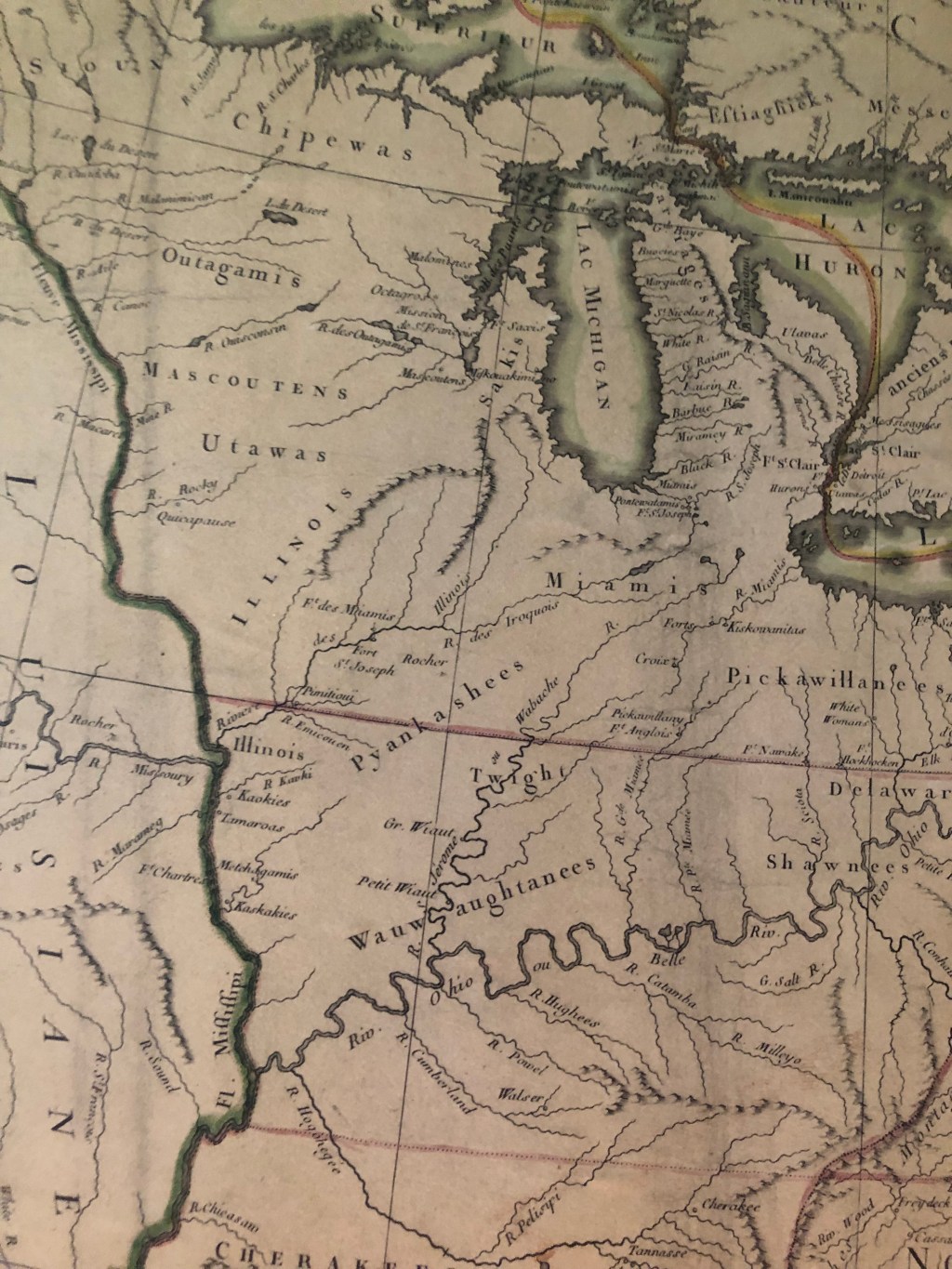
    Before we were St. Charles County Missouri, we were St. Charles County in the Missouri Territory. And before that we were Louisiana Territory. We were purchased as part of the Louisiana Purchase by Thomas Jefferson in 1804 from the French. But the French and Spanish had treatied and traded this land for years before that. And yes, before all of that, this was the home to thousands of Native Americans, many of which had previously lived further east. They had been forced west by the settlement in our original colonies, and then the “Far West” which Indiana and Illinois were once called. In other words, this land that we call St. Charles County now, has been home to many people and many cultures in these past 250 years.

    In the 1760s, the French and Spanish had started sending explorers, in amongst the Native Americans. Soon French Canadians, who were having difficulties with the British, like we were, started looking for new locations to settle. People like Chouteau and Blanchette. Rivers were the pathways, used by both the Native Americans and the French and Spanish. While all of this was happening here though, America was being born. Based on the principles of Democracy, that we all fought hard for. And while we thought that those battles would never spill over into our territory, we were prepared and yet so happened the battle of San Carlos in St. Louis. By the late 1700s, Americans were looking for new territory to settle, and so came the first waves. Those that came had slaves. Many had come from Virginia, and Kentucky, which had just been carved out of the Commonwealth of Virginia. They were used to living under the Code Noir, the Black Code, which had dictated how they dealt with their property.

    The Code Noir regulated the institution of slavery and the rights of all Black subjects–whether free or enslaved–within the French Empire. First issued as an edict under King Louis XIV in 1685, the Code Noir was enforced by French authorities in the Louisiana Territory as the nation expanded its landholdings in what would later become the United States. The Code Noir remained in effect after France ceded the Louisiana Territory to Spain in 1762 and remained on the books until the United States acquired these lands through the Louisiana Purchase of 1803-1804. Parts of the Code Noir would later show up in the Missouri State Constitution after statehood was acheived in 1821. [https://www.nps.gov/articles/000/transcription-of-the-code-noir-the-black-code.htm]

    That is why when Missouri finally became a State in 1821, the issue of slavery was handled the exact same way it had been since 1685 under King Louis XIV. In looking back, that’s exactly where we started. And in 1821, it was very common for all of the property owners, to own enslaved property. And as property, they did not have names, they did not know things, as simple as their birthdate. We became a State that was built on the institution of slavery. The first settlers that settled St. Charles County, were people who built their homes with that labor. Whose meals were cooked, cattle were fed, and children were cared for by black people. They were there, and they have been invisible in our history, for way too long. Most of us didn’t learn it in school, and many of our children aren’t learning it today in our schools. We are removing it daily. Its’ time we acknowledge all history. Not just the good or bad, but the ugly as well. That’s how we learn from our mistakes. As Winston Churchill said

    History happens. I feel that as a writer, and a historian, its important to include all people and cultures. And, they should be honest and true, which takes research. Sometimes those are stories we don’t want to see or hear. What’s the old saying? The truth hurts. I like to compare “society” to a person. When a person is born, they are a blank slate. Their parents are their first teachers. One of the first words a toddler learns is no. And when they make a mistake, they learn the meaning of no, and they don’t repeat it hopefully. And when they reach school age, a whole new world opens open. And as they learn about that world, if they don’t learn about the mistakes, they won’t know how not to repeat them. I’m still learning, always searching for the truth, the whole story, and to know what really happened. And then I will share it as best I can. The stories shared here are my own.

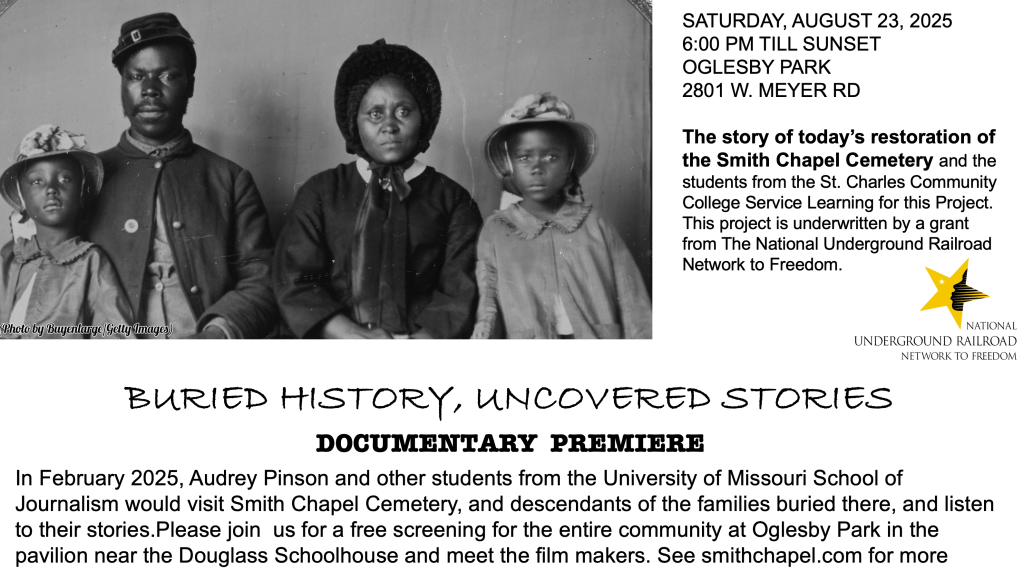
  • BURIED HISTORY, UNCOVERED STORIES PREMIERE

    In 2023, a small one-acre plot of land called Smith Chapel Cemetery was recognized by the National Park Service’s Program, the NATIONAL UNDERGROUND RAILROAD NETWORK TO FREEDOM, due to the resilience and courage of three enslaved men who were seeking their freedom using the Underground Railroad. In the winter of 1864, at the height of the Civil War, they would flee their enslavers and join the Union Army’s U.S. Colored Troops.

    In 2024, the Wesley Smith Church in Wright City was granted funds for a project funded by the National Park Service’s NATIONAL UNDERGROUND RAILROAD NETWORK TO FREEDOM for the Smith Chapel Cemetery Restoration, to enable them to hire a professional Cemetery Restorer named Jerry Prouhet and for historian and writer Dorris Keeven-Franke to work with Professor Grace Moser and her students at St. Charles Community College. The students are taking the Service Learning Class American History 101 and 102 and are helping to research the signs that will be erected to tell the story of Smith Chapel.

    In February 2025, Journalism Students from the University of Missouri in Columbia became aware of the project, and wanted to learn more about the cemetery and its’ people. Join us on August 23, 2025, in Oglesby Park, 2801 W. Meyer Road, (St. Charles County Parks) in Foristell, from 6pm til Sunset as we premiere their documentary called BURIED HISTORY, UNCOVERED STORIES. The public is invited; this event is being held by those working on the cemetery, who want to share the story with everyone. The screening will be outdoors in the pavilion at the back of the Park near the Douglass Schoolhouse. Please bring lawnchairs. For more information, email stcharlescountyhistory@gmail.com

    For more about Smith Chapel Cemetery, see smithchapelcemetery.com

    To receive a free daily email with more St. Charles County Stories….