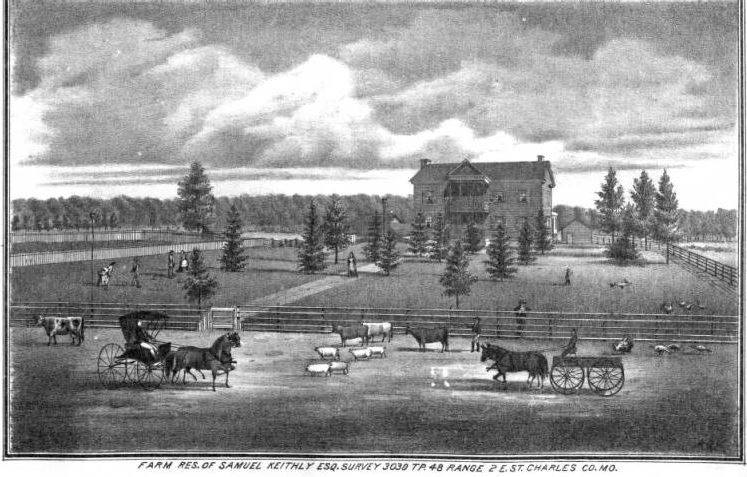
In the early 1800s, Samuel Keithly (1789-1870) came from Kentucky, and settled in St. Charles County, bringing his enslaved. The father of a large family with seven children, several step-children, and many grandchildren, the family had other members who owned slaves as well. By the 1840s, the family owned hundreds of acres of land, and had purchased land near today’s O’Fallon, Missouri where Sage Chapel Cemetery lies. Keithly was one of the largest slave owners in St. Charles County according to the U.S. Slave Schedules of 1850 and 1860. Among those who he enslaved were John Rafferty and his sisters Ludy, Elsie and Lizzie according to Mary Stephenson.
Samuel Keithly didn’t free any of his enslaved. Some histories state that he gave the land that we call Sage Chapel Cemetery to his slaves, where they worshiped in a field of Sage. What we do know was that among Samuel Keithly’s slaves was John Rafferty. According to Mary Stephenson, who is his descendant, John Rafferty and his sisters, Frances, Ludy, Elsie, and Lizzie had been born in Kentucky, and brought to Missouri.
When John Rafferty (Senior) passed away in 1881, his former enslaver Samuel Keithly (Senior) had already passed away as well. But burials had already been taking place on the former Keithly plantation, on the same land that had been inherited and was by then owned by his daughter Mahala Keithly Castlio (1817-1896) and her husband Jasper N. Castlio. This was the same land that the enslaved people had been burying on for generations before. And they wanted to keep burying in the same graveyard.
So in 1881, Samuel Kiethly’s daughter Mahala and her husband Jasper Castlio legally transferred property that included a small church building of the African Methodist Episcopal Church on “the hill” [today’s Sonderen Avenue] and the cemetery which lay at its southern terminus to three A.M.E. Trustees. On August 20th, in 1881, Mahala and her husband Jasper, transferred to three Trustees of the African Methodist Church, namely John Rafferty’s close friend Walter Burrel, Joel Patterson and Taylor Harris, for the use of the preachers of the African Methodist Episcopal Conference (headed by St. John’s A.M.E. Church in St. Charles Missouri). They also sold them one acre of land, which became known as Sage Chapel Cemetery, so that burials could continue to take place in the same “black cemetery” that they had been burying in for generations, and then former slaves, like John Rafferty and Charles Letcher could continue to be buried alongside, with their families and where their ancestors had already lain for decades.
These are among at least 17 burials at Sage Chapel Cemetery that we know experienced Missouri’s Emancipation Day on Missouri’s Emancipation Day on January 11, 1865 or Juneteenth. You won’t see them in the picture of Keithley’s Plantation published in the St. Charles County plat book.
Want more stories like this every day in your email box?
 ST. CHARLES COUNTY HISTORY