ST. CHARLES COUNTY HISTORY

By Dorris Keeven-Franke

  • The Osage Nation

    By Michael Dickey – Former Site Director, Arrow Rock State Historic Site, Missouri Department of Natural Resources from a Program: April 25, 2015  Conflicted Perspectives Symposium, St. Charles County College

    In 1803, the 6,000 strong Osage Nation was the largest, most powerful Native American nation immediately west of the Mississippi River. Adding to that image of power, Osage men averaged over six feet in height, some even reaching seven feet, such as Chief Black Dog painted by western artist George Catlin in 1834. In contrast, the average height of a white American male was only 5 ft. 8 in., strengthening “the idea of their being giants.”[1] The Osage were divided into three bands; the Big Osage on the Osage River, the Little Osage on the Missouri River until about 1795 but now on the Osage River, and the Arkansas Osage on the Verdigris River in northeast Oklahoma. The Osage dominated the region from northern Missouri to the Red River and from the Mississippi valley to the western plains of Kansas and Oklahoma: about 1/8 of the Louisiana Territory.[2]

    They aggressively defended their territory against all intruders, Indian and white alike. The Osage could bring all of their 1,250 veteran warriors to bear on a single target in a “grand war movement” a feat that few Indian nations in North America could accomplish.[3] In contrast, the United States had only about 250 soldiers available on the western frontier. Following a meeting with Osage leaders in 1805 President Thomas Jefferson wrote, “…in their quarter, we are miserably weak.”[4] The Osage delegation also visited Boston early in 1806 where Chief Tatschaga delivered a testimonial before the Massachusetts State Senate on how the Osage saw themselves in relation to the United States: “Our complexions differ from yours, but our hearts are the same color, and you ought to love us for we are the original and true Americans.[5]

    By 1808, the Osage became restive as displaced eastern tribes and whites increasingly encroached on their territory. Pawhuska or White Hair the so-called “principal chief” or “grand chief” of the Big Osage was pro-American. The position of the chiefs (actually called headmen) was hereditary; if they lived up to the task for a bad chief could be deposed simply by his people ignoring him.   But the real political and spiritual power of the tribe lay with the Non-hon-zhin ga or Little Old Men, a select group of elders imbued with sacred knowledge and tribal history. Chiefs followed the leading and advice of the Little Old Men. European traders and officials interfered with this traditional tribal government by giving gifts and medals to individuals they believed would influence the tribe on their behalf. Pawhuska was not a hereditary chief. St. Louis fur traders Pierre and Auguste Chouteau as representatives of the Spanish government had awarded him medals around 1795. This may have helped further a political schism that was already causing some Big Osage to break away and form the Arkansas Band. [6]

    Dissidents to Pawhuska’s leadership harassed American settlers by stealing their horses and killing their cattle. Meriwether Lewis, now the Governor of Louisiana Territory ordered the cessation of all trade with the Osages and invited the Shawnee, Delaware, Kickapoo, Ioway and Miami and Potawatomi to wage war on them.[7] Those tribes did not require much goading because they desired to possess the Osage country which was still rich in wild game, while the wildlife resources in their own territories were rapidly becoming depleted.

    Jefferson wrote Lewis that military force should be a last resort, so the attack was called off. “Commerce is the great engine by which we are to coerce them & not war[8] he told Lewis. Jefferson’s strategy was to create Osage dependence on American commercial trade, thereby creating indebtedness within tribes that they would pay off by ceding land. Reducing their hunting territory in this manner, he believed, would force them to become farmers out of necessity and they would be gradually assimilated into American agrarian society a process taking 50 or more years. He was encouraged by the progress he saw then occurring with southeastern tribes such as the Lower Creeks and Cherokees. But Jefferson failed to understand just how rapidly the frontier would advance and how resistant to cultural change the Osage would be. Furthermore, Missouri frontiersmen did not share Jefferson’s ideals about assimilating the Osages into American society.

    Endnotes

    • [1] Bradbury, John. Travels in the Interior of America in the Years 1809, 1810, and 1811. London: Sherwood, Neely and Jones, 1819 p. 11
    • [2] Burns, Louis A History of the Osage People University of Alabama Press, Tuscaloosa AL 2004, pp. 27-37
    • [3] Osage elder Jim Red Corn cited in “The Osages at Home in the Center of the Earth – Wa sha she U ke Hun ka U kon scah” an exhibit held in conjunction with Osage Tribal Museum at Arrow Rock State Historic Site, 2004-2005.
    • [4] Ambrose, Stephen. Undaunted Courage: Meriwether Lewis, Thomas Jefferson, and the Opening of the American West Simon and Schuster, 1996, p. 342
    • [5] The Smithsonian Journal of History, John C. Ewers, Chiefs of the Missouri and Mississippi Vol. I, 1966 p. 22
    • [6] Burns, pp. 129-131
    • [7] Lewis to Dearborn July 1, 1808 Indian Claims Commission 733 Docket No. 105 The Osage Nation of Indians, 1962 p. 858 http://digital.library.okstate.edu/icc/v11/iccv11bp812.pdf
    • [8] Jefferson to Lewis August 21, 1808. The Writings of Thomas Jefferson. Published by the Thomas Jefferson Memorial Association Washington, D.C. 1904 p. 142

    From the Gilchrist Museum: Title(s): Chief White Hair, Pawhuska, Oklahoma, Creator(s): Unidentified (Author),Culture: Native American, Osage,Date: 1850 – 1900,Classification: Photographs, Object Type: Photographic Print, Accession No: 4326.4129, Previous Number(s): 72949, Department: , Archive Collection: , Oklahoma Native American Photographs Collection.
    JOIN OUR GROUP ON FACEBOOK

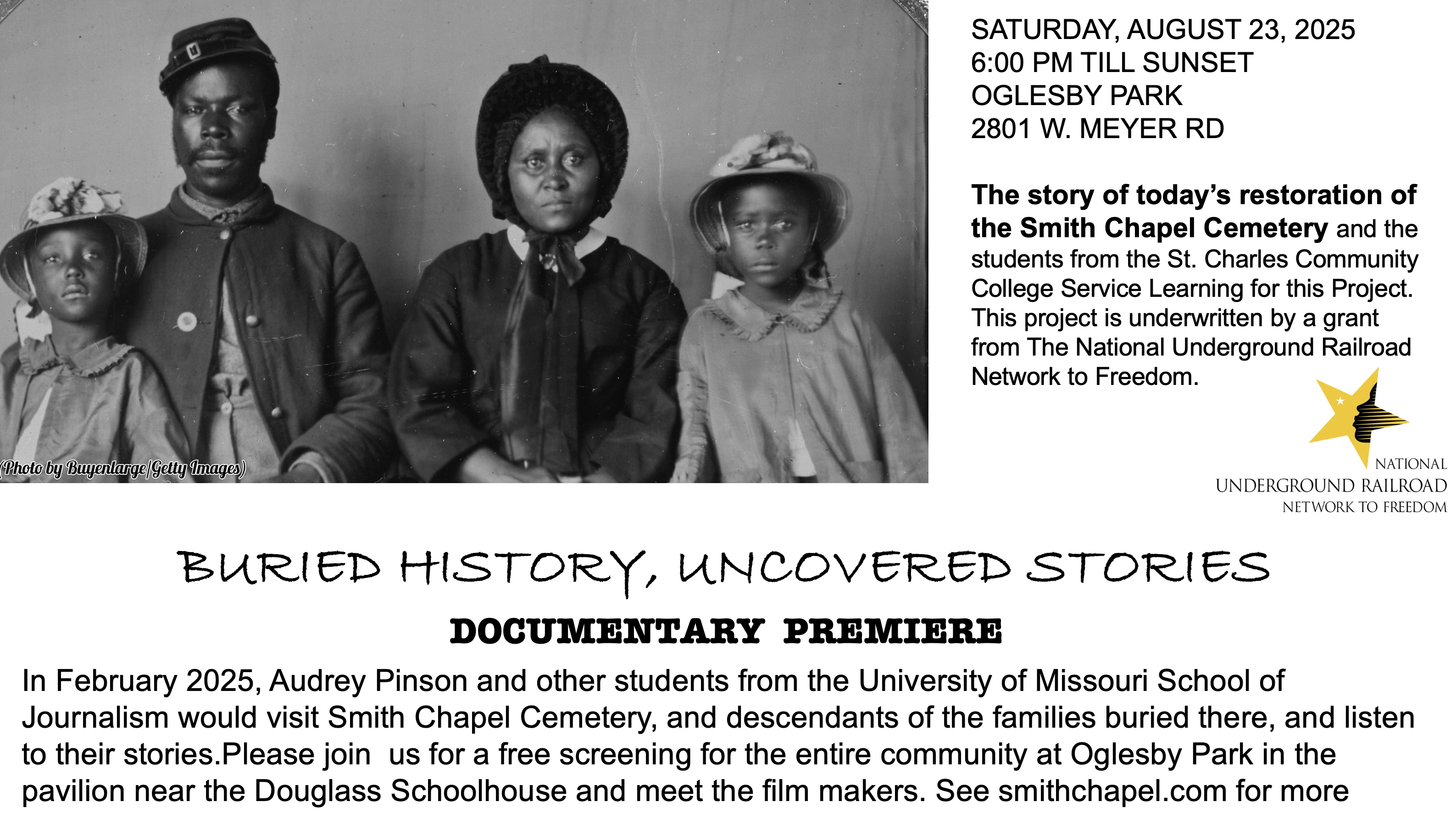
  • BURIED HISTORY, UNCOVERED STORIES

    The Smith Chapel Cemetery in Foristell, Missouri is listed on the National Underground Railroad Network to Freedom. It is one of over 800 sites across this country that document stories like theirs. The program is a catalyst for innovation, partnerships, and scholarship connecting the legacy of the Underground Railroad across boundaries and generations. The program consists of sites, programs, and facilities with a verifiable connection to the Underground Railroad. There are currently Network to Freedom locations in 40 states, plus Washington D.C., the U.S. Virgin Islands and Canada.

    Established in 1871, Smith Chapel Cemetery is an African American burying ground established by nine formerly enslaved individuals in St. Charles County Missouri. At least three men were freedom seekers, and members of the Smith Chapel African Methodist Episcopal Church associated with this graveyard. The cemetery is final resting place for Smith Ball (1833-1912), Benjamin Oglesby (1825-1901), and Martin Boyd (1826-1912) who each took steps toward freedom and joined the United States Colored Troops, despite the risks involved for themselves and their families. Living in a border state, these families were caught between the conflict of both Union Troops and Confederate guerilla soldiers. Under Martial law, many Missourians strongly opposed the formation of Colored Troops, only allowing those enslaved to serve as substitutes in their place and to fill County quotas. These freedom seekers, like many others, escaped slavery by the underground railroad, enlisting without permission. Slave Patrols, who kept constant watch of the roads for those attempting freedom, would either return those seeking their freedom to their former enslaver or enforce methods of punishment, which could include death. After the war, these men returned to their families to join others in creating this community.

    For 2025, the Smith Chapel Cemetery was awarded a grant by the Network to Freedom to hire a professional cemetery preservationist, Jerry Prouhet, to restore the headstones in the cemetery. It also gave funds for four informational signs to be placed in the cemetery, one at the front that identifies the property, one at the site of the Douglass Schoolhouse (now recreated in Oglesby Park) and one at the Cemetery that will list all of the names of the people buried in the cemetery. The grant also includes for the students at the St. Charles Community College, taking American History 101 Service Learning to actively get involved with the research for the signs, restoring the cemetery, recording Oral Histories, working with their Professor Grace Wade Moser and historian Dorris Keeven-Franke.

    In February of 2025, Audrey Pinson and other students from the University of Missouri Columbia – School of Journalism, contacted those working on this project and began work on a documentary about the Smith Chapel Cemetery. The public is invited to the Premiere showing of this documentary on August 23, 2025 at 6:00pm where the film makers, members of the project, descendants of those buried at the cemetery, and students will be available to talk about this wonderful project. Everyone is invited, open to the public, please bring a lawnchair!

    FOR MORE INFORMATION ABOUT THE SMITH CHAPEL CEMETERY SEE ITS WEBSITE SMITHCHAPELCEMETERY.COM

  • August 10,1821

    Two hundred years ago, Missouri became a State on August 10, 1821. Its birth was not easy though. The land was purchased by the United States in 1804, and organized into  a Territory in 1812, with the first Legislative session held in Pierre Choteau Senior’s home. For the second session they were at the home of Madame Dubrevill on Second Street, also in St. Louis.

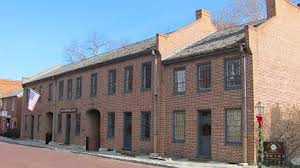
    Residents wanted to discuss Statehood, so they gathered at E. Maury’s Hotel on October 26, 1818. There they began to draft a Constitution, which was completed when the Convention met at the Mansion House on June 12, 1820. This was a large 3 story brick on the corner of Third and Vine Streets, that had been built in 1816. At this session, the Convention also drafted a resolution that the seat of government would remain at St. Louis until 1826, when it would be moved to a point on the Missouri River within 40 miles of the Osage River. The rivers were the highways of their day.

    The first session of the Missouri General Assembly was convened in St. Louis, and the election returns counted, with Alexander McNair becoming the first Governor. This was followed by high drama at the Missouri Hotel, at Main and Morgan Streets. U.S. Senators were elected by a caucus of a joint General Assembly, and the first seat went to David Barton by a unanimous decision. However, a bitter fight broke out between Judge John B. Lucas and Thomas Hart Benton. For days the 14 State Senators and the 43 members of the House debated and remained in a deadlock. It grew acrimonious and bitter. Then someone remembered that Representative Daniel Ralls had not come down from his room because he was ill. Needing the stalemate to end, a group of Benton supporters, carried his bed down to the Dining Room, where he feebly announced his vote for Benton. He died within a few days.

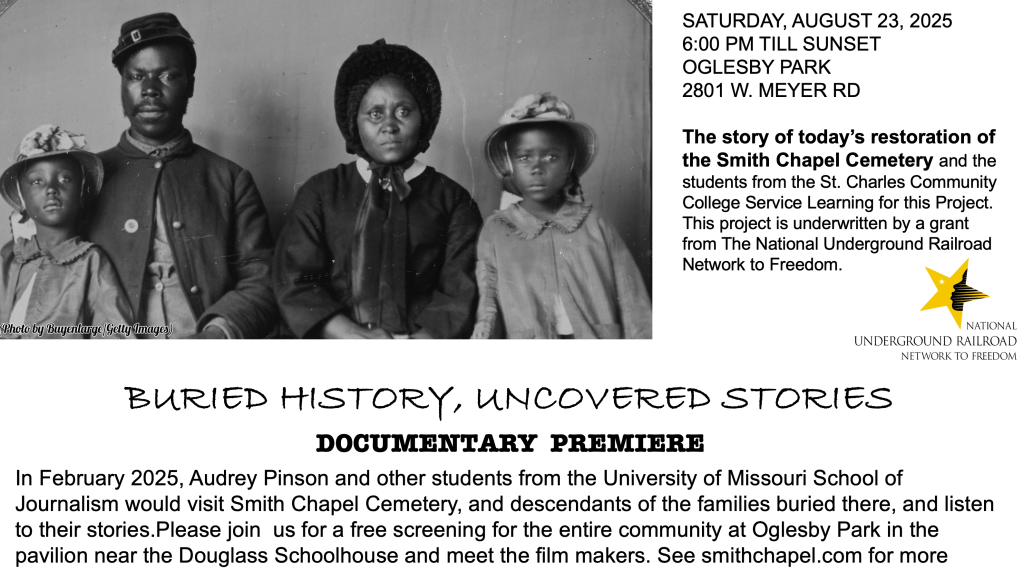
    Before it adjourned, and after  yet another long fight, they named Saint Charles the Mointeroirestemporary Seat of Justice.  McNair convened a special session on June 4, 1821 to discuss the objections raised by the U.S. Congress, on the second floor of a brick building on Main Street. That summer the heated debate over slavery floated down to listeners in front of the Peck Brothers Mercantile. A great compromise suggested by Henry Clay, ended the debate. Missouri was a slave state with the institution part of its history from its very beginning. With 11 free states, and 11 states in the Union, it would take the free state of Maine to balance Missouri’s entry as the 24th State.
    Whereas the Congress of the United States, by a joint resolution of the 2d day of March last, entitled “Resolution providing for the admission of the State of Missouri into the Union on a certain condition,” did determine and declare “that Missouri should be admitted into this Union on an equal footing with the original States in all respects whatever upon the fundamental condition that the fourth clause of the twenty-sixth section of the third article of the constitution submitted on the part of said State to Congress shall never be construed to authorize the passage of any law, and that no law shall be passed in conformity thereto, by which any citizen of either of the States of this Union shall be excluded from the enjoyment of any of the privileges and immunities to which such citizen is entitled under the Constitution of the United States: Provided, That the legislature of said State, by a solemn public act, shall declare the assent of the said State to the said fundamental condition, and shall transmit to the President of the United States on or before the first Monday in November next an authentic copy of said act, upon the receipt whereof the President, by proclamation, shall announce the fact, whereupon, and without any further proceeding on the part of Congress, the admission of the said State into this Union shall be considered as complete;” and

    Whereas by a solemn public act of the assembly of said State of Missouri, passed on the 26th of June, in the present year, entitled “A solemn public act declaring the assent of this State to the fundamental condition contained in a resolution passed by the Congress of the United States providing for the admission of the State of Missouri into the Union on a certain condition,” an authentic copy whereof has been communicated to me, it is solemnly and publicly enacted and declared that that State has assented, and does assent, that the fourth clause of the twenty-sixth section of the third article of the constitution of said State “shall never be construed to authorize the passage of any law, and that no law shall be passed in conformity thereto, by which any citizen of either of the United States shall be excluded from the enjoyment of any of the privileges and immunities to which such citizens are entitled under the Constitution of the United States:”

    Now, therefore, I, James Monroe, President of the United States, in pursuance of the resolution of Congress aforesaid, have issued this my proclamation, announcing the fact that the said State of Missouri has assented to the fundamental condition required by the resolution of Congress aforesaid, whereupon the admission of the said State of Missouri into this Union is declared to be complete.

    imgres