Ever wonder why so many Saint Charles families trace their ancestry back to Germany? Some would say one visitor who arrived in 1824 might just be the reason. He would spend three years here visiting with Nathan Boone, Jacob Zumwalt, and others, observing the life of those who had already uprooted their families and headed west. They had a reason to head to this new territory….
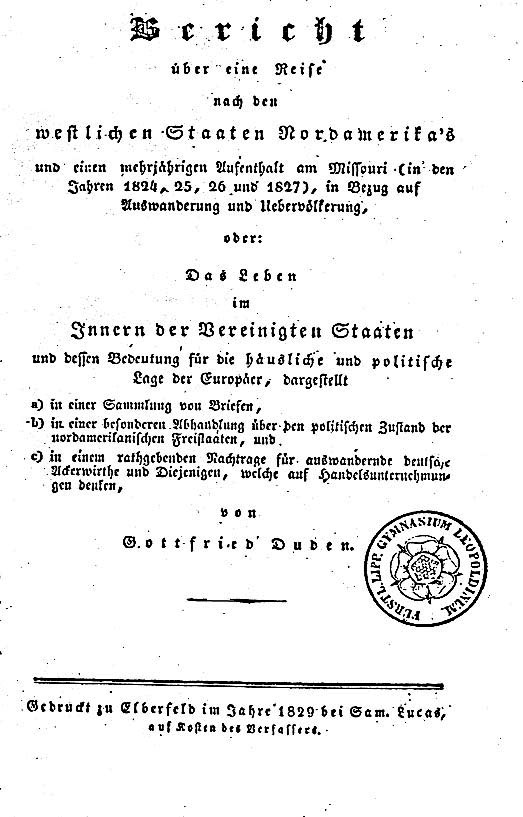
In 1829, Gottfried Duden published at his own expense 1500 copies of a small book titled Report on a Journey to the Western States of North America in Elberfeld Germany. In 1909, eighty years after Duden’s Report was published, A.B. Faust described Duden with, “His skillful pen mingled fact and fiction, interwove experience and imagination, pictured the freedom of the forest and of democratic institutions in contrast with the social restrictions and political embarrassments of Europe. Many thousands of Germans pondered over this book and enthused over its sympathetic glow. Innumerable resolutions were made to cross the ocean and build for the present and succeeding generations happy homes on the far-famed Missouri.”
In 1919, ninety years following Duden’s Report, Duden’s first biographer William G. Bek begins with, “Duden was the first German who gave his countrymen a fairly comprehensive, and reasonably accurate, first-hand account of conditions as they obtained in the eastern part of the new state of Missouri.”
In Mack Walker’s Germany and the Emigration 1816-1885 we find, “Duden’s enthusiastic book . . . fits its time with a gratifying neatness; for it first appeared in 1829, just as the Auswanderung to America was beginning to revive. But it not only met a need and suited an atmosphere it helped appreciably to create them. Duden’s descriptions of American landscapes and American resources were vivid, even lyrical. He found American economic, political, and social conditions better than those of the Fatherland, and American intellectual and moral conditions just as good. The color, timing, and literary qualities of Duden’s report made it unquestionably the most popular and influential description of the United States to appear during the first half of the century. It was an important factor in the enthusiasm for America among educated Germans in the thirties; it served for decades as a point of departure for hundreds of essays, articles, and books, and innumerable thousands of conversations; it was a landmark in the life and memory of many an Auswanderer.”
Nearly one hundred twenty-five years following Duden’s Report, Charles van Ravenswaay in his epic The Arts and Architecture of German Settlements in Missouri: A Survey of a Vanishing Culture tells us, “This timely work . . . greatly stimulated immigration to the United States and caused thousands to make Missouri their destination . . . For more than a generation Duden’s writings formed the leitmotif of German settlement in Missouri, with the interpretation of his comments provoking endless discussion among those who came here. Many immigrants continued to revere his memory as the father of the German migration, and even those who blamed him for their misfortunes seem to have had a grudging respect for that kindly, guileless man.”
Born in 1789 in the small town of Remscheid, Duden was the son of a wealthy apothecary and his second wife. When Duden was six years old his father died, leaving a widow and five children, and Duden the middle child with two older brothers, and two younger sisters. When one of the older brothers died, Duden was only nine, more thought was certainly placed on whether he would follow in the family’s apothecary business. Instead his chosen career became law. And as an impressionable, wealthy and highly educated young man, he would suddenly find himself seated behind the law bench in Dusseldorf, listening to the horrid tales of woe, from a world he was certainly not familiar with. His military service, done without pay, raised his awareness further, about the conditions and the problems his country was facing. His generation’s students at the Universities were pushing to change these problems. Others, such as Frederick Ludwig Jahn, with the Turner movement, spoke out about the need for a need for a united Germany, with strong minds and bodies. With the foresight to see, that if the struggles his fellow countrymen faced, could not be changed, perhaps a fresh start in that young country in North America should be made. Duden was not the first, nor was he the only German author to consider authoring an “emigration book” as hundreds were being published by this time. But did they know what they were talking about? Most authors had never even been there, and those that claimed to, Duden would soon discover really had not. Inspired by the tales of pioneers such as Daniel Boone, Duden began to look closer at the new territories opening in the far west.
Using an agent, in 1819, Duden purchased property in the U.S. Land Office. It lay near the Fifth Principal Meridian, in what had been Saint Charles County, but was then Montgomery County, and today is Warren County, the village of Dutzow. He developed a plan, which would be thwarted when a chosen companion died in South America. Soon he would have another, Ludwig Eversmann, and he, and his cook Gertrude Obladen, would join him in the young State of Missouri, where he purchased even more land.
For three years, Duden would write about his time in the Western States, compiling notes about everything from his neighbors to the conditions of the U.S. Government. Thorough, he covered the issues of slavery, the American Indians, and farming, from a nearby hillside on Jacob Haun’s farm. Farming, was only by observation, as that was what he had brought Eversmann for. He roamed the countryside and went duck hunting with Nathan Boone. When he readied for his return to Germany, the locals asked why he was going back to conditions he considered so bad, and he stated that Eversmann would stay and take care of his farm, but Duden’s mission was to publish a book. A book in which he would compare, like no other at that time, Germany to North America. He would report, in a matter of fact manner, how a farmer could purchase land, raise a family, and worship freely in the church of his choice. He was free to raise all the crops he wanted on his land, and kill all of the meat his family could eat, that his labor allowed. He was free to marry, cut whatever wood he needed for his house and his fire, and vote to decide on his leaders. He was free. Here one was free to do all of these things, while in Germany most were not. With no military draft, no inheritance laws, and no high taxes, this would sound like a virtual Schlafferenlande – a Garden of Eden.
When Duden’s A Report on a Journey to the Western States of North America hit the bookstores in 1829, it was an instant hit! It literally flew off the bookstores’ shelves, going straight to the top of the bookseller list, and had everybody talking, all without the help of today’s blogs, tweets and Facebook. Included in the back was Duden’s advice to the farmer, and suddenly everybody wanted to be a “farmer”! Soon thousands would leave German ports such as Bremen, and arrive at Baltimore or New Orleans, declaring them self a farmer. For the first decade, Duden’s advice to travel through Baltimore and in groups, for safety, was usually heeded.
First only a small trickle, with the little so called Berlin Society, funded by Baron von Bock, establishing Dutzow, named after his estate in Germany. Soon to be followed by a ships filled with Germans from Osnabruck and then Soligen, hundreds more soon filled the Missouri River valley. Emigration Societies in Germany and Switzerland republished Duden’s book, with second, third and fourth editions soon to follow. Emigration Societies here in the U.S. were formed, in Philadelphia, which purchased land and sold shares, creating Missouri towns like Hermann.
The impetus was on, and when charismatic leaders such as Paul Follen, and Friedrich Muench, with their Giessen Emigration Society, gave a call for a large group to emigrate in mass, the response was huge! Their impossible goal to create a German Republic in the United States as they originally planned may have failed, but the idea of a State where Germany’s cultural heritage could live on, definitely did not. Thousands wanted to be part of Muench and Follenius’ movement, and seek their freedom and fortunes in the New World.
Not only to be restricted to the wealthy, freedom for religious faiths would soon find inspiration in Duden’s book, with leaders like Martin Stephans, who corresponded with Duden. And finally, in the end, not to be restrained by class or religion, entire villages would be emptied, as letters home or chain migration picked up the baton passed on to them. Soon Duden’s book, would be replaced somewhat, by even more personal, first hand accounts written by his followers. These letters, written by relatives to family members still in Germany, and shared after church on Sunday, in the wine garden, or during drills at the Turnverein, kept the waves of emigrants coming. With stories of how they ate more meat in a day or week, than their relatives did in a month. Or, how with a little hard work, they could purchase land, to raise large families. And how best of all, they were free, free to speak their own mind, to be part of the electoral process and to worship where they chose.
While I could go on, and would love to continue, about the achievements of these early emigrants and their bold moves which brought us to today.
Gottfried Duden died on October 29, 1856. And while he never returned to Missouri, he did keep his own dream alive, with ownership of his small Missouri farm with the cows on it. Today, one can still purchase books on the subject of emigration, in both Germany and the U.S. and find Gottfried Duden included. Duden’s personal ambition to help his fellow countrymen was fulfilled with his Report. While criticized for his romantic descriptions, immigrants could not deny that “while all things were not exactly as Duden described, in some ways they were even better.” His Report, inspired great leaders, and gave rise to thousands, to chose to emigrate to the land where “the sun of freedom shines” forever. This legacy lives on today, in the hundreds of thousands of immigrants, and their descendants, in the United States.
Today, we can still find evidence of those early emigrants in our architecture, customs and traditions. Our history books cite their roles in the Civil War, and in the industry found in their businesses. We celebrate our holidays with Christmas trees and cookies. We toast our successes with wine. Our love of parties and celebrations, of commemorating each moment, cannot be quashed by blue laws. We educate our children starting with Kindegarten, and teach the importance of schooling, freely, and for all. Today still, our traditions keep the dreams, the culture, and the faith of those first bold moves alive.
SUBSCRIBE AND GET FREE DAILY EMAILS OF STCHARLESCOUNTYHISTORY


 ST. CHARLES COUNTY HISTORY
You must be logged in to post a comment.