History happens. All stories, especially the difficult ones, need to be heard. Award winning author, a public historian, professional genealogist, and International speaker. Member of the Missouri Speakers Bureau and the National Underground Railroad Network to Freedom.
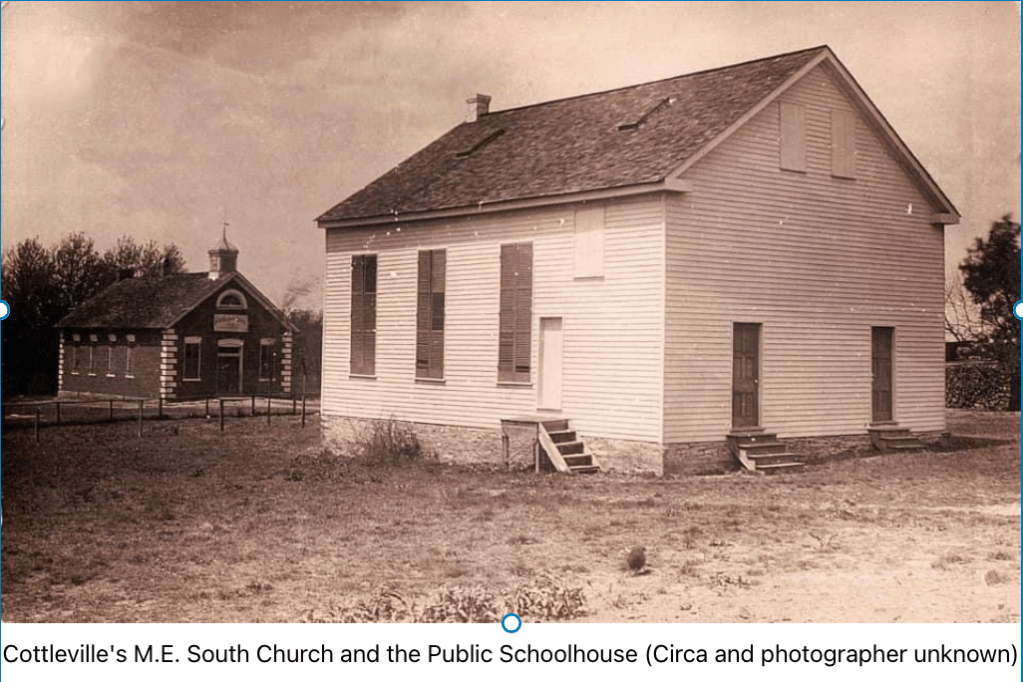
On Cottleville’s Chestnut Street sits a large two-and-one-half story frame building that once served its’ Methodist Episcopal South congregation. By 1811, John Pitman, a veteran of the Revolutionary War had come to Missouri from Kentucky, settling just to the south of the Cottle family. Portions of his huge estate would provide two additions to the town of Cottleville. John Pitman was owner of a large amount of enslaved property. He had been born in what was Bedford County Virginia in 1757. In 1776, Kentucky would become a County of Virginia, and eventually a state in 1792. By 1800, we find Pitman paying taxes on that property in Kentucky. However, many early Missouri settlers were like Pitman, and had received payment for their service in the Continental Congress in the form of a Land Warrant, in the newly acquired Louisiana Territory. In February of 1805, John married Magdelene Irvine, and their son David Kyle Pitman was born that December. The Methodist religion had come to Missouri with the preachings of John Clark in 1816. According to the Methodist Archives at Central Methodist University in Fayette “In 1844 when the Methodist Episcopal Church separated into the MEC and the MEC, South, Missouri officially went South. Both churches operated in Missouri, many times side-by-side in the same town“. By 1854, John Pitman’s son David, and his son Richard would join with others to build a frame church building at the cost of $1,600. Other founding members were William C. Ellis, S. R. Watts, and James T. Sanford.They would start out with 20 members. Their enslaved would sit in the gallery upstairs.
The photograph below shows Cottleville’s Public School in the background. The Boone’s Lick Road passes through the town of Cottleville.
In 1804, America was excited to know what lay out there past the Mississippi in that new purchase called the Louisiana Territory. President Thomas Jefferson would appoint his Secretary Meriwether Lewis to lead an expedition with an assignment to find a passage to the Pacific Ocean, thinking the Missouri River would take them there. Lewis chose his friend William Clark to accompany him. Since the final word on the purchase had not reached the Spanish Commandant, the Corps of Discovery was not allowed passage across the Mississippi River, and would be forced to spend the winter of 1803-04 in preparations on the Illinois side of the river. Today Hartford, Illinois is the site of a fantastic museum that shares this story.
Artwork of Artist Gary Lucy
A fair morning, Set out at 5 oClock passed the Coal hill (Called that by the native Carbonear [Charbonnier]) this hill appears to Contain great quantytes [sic] of Coal, and also ore of a rich appearance haveing greatly the resemblance of Silver. Arrived Opposit St Charles at 12 oClock, this Village is at the foot of a Hill from which it takes its real name Peeteite Coete [Petite Côte] or the little hill, it contains about 100 indefferent houses, and abot 450 Inhabetents principally frinch, those people appear pore and extreemly kind, the Countrey around I am told is butifull. interspursed with Praries & timber alturnetly and has a number of American Settlers Took equal altituds with sextion M a [median altitude?] 68° 37′ 30″ Dined with the Comdr. & Mr. Ducetts [Duquette] family— May 15, 1804– William Clark
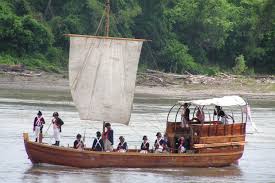
Discovery Expedition of St. Charles reproduction featured in several documentaries.
From the Journal of Joseph Whitehouse, a member of the Lewis and Clark Expedition in May of 1804. Wednesday the 16th We set out this morning, having clear weather, and proceeded on very well, about 2oClock P. M we arrived at Saint Charles, where we passed the Evening with a great deal of satisfaction, and chearfulness, and all our men appeared to be in good spirits.
We shall waite here for Captain Lewis, who is to meet us from Saint Louis. Saint Charles is a Village settled by French Inhabitants. It is a handsome situation, laying on the North side of the River contains about 80 Houses, built in the french fashion, and has a small Roman Catholic Chapel. its Inhabitants are chiefly canadian french; who are chiefly concerned & employed by others Trading with the Indians who reside on the River Mesouri, and other Rivers that empty into it. The land adjoining it appear to be hilly, but the soil is good and fitting for Agriculture.—Saint Charles lies in Latitude 38° 54′ 39 North & 19 Miles from the Mouth of the Mesouri River,
Artist Gary Lucy portrayal of the Village of St. Charles
St. Charles is the earliest white settlement west of the Mississippi and north of the Missouri. As Captain William Clark notes, the place was first called Les Petites Côtes (the Little Hills). In 1787, Auguste Chouteau surveyed the settlement, and soon after the district of St. Charles was established. The parish church, and hence the settlement, was named for St. Charles Borromeo. To the Spanish it was San Carlos del Misuri. By the time of the Louisiana Purchase, the French inhabitants of the town were surrounded by American settlers in the countryside, including Daniel Boone and his family who had settled in the area in the late 1790s. Missouri Guide, 260–64; Houck, 2:79–86; Osgood (FN), 41 n. 8.
Because of discrepancies in the records and journals, especially concerning the French boatmen, it is difficult to determine exactly the number of men who left River Dubois with Clark. George Drouillard was absent on an errand and may not be the Frenchman singled out by Clark; possibly he was Baptiste Deschamps, the patroon (foreman) of the hired French boatmen, although later he seems to have been in charge of a pirogue..
The exact number and names of the French boatmen remain unclear throughout (see Appendix A). Clark may not have counted York, an African American and his personal servant, in his total. Among those leaving Wood River, besides Clark and York, were twenty-five members of the permanent party, as then planned, who were to make the full trip to the Pacific: Sergeants Floyd, Ordway, and Pryor, and Privates Bratton, Collins, Colter, Reubin and Joseph Field, Gass, Gibson, Goodrich, Hall, Howard, McNeal, Newman, Potts, Reed, Shannon, Shields, Thompson, Werner, Whitehouse, Willard, Windsor, and Weiser. Corporal Richard Warfington’s detachment, who were to return from some point up the Missouri with dispatches, then included Privates Boley, Dame, Frazer, Tuttle, and White. Private John Robertson (Robinson) may also have been present at this time; perhaps he was one of the six soldiers in a pirogue—probably Warfington’s squad.
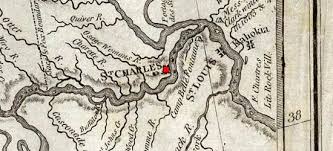
St. Charles location on the map by James Mackay used for the Lewis and Clark Expedition of 1804
The enlisted men’s journals all state that there were three sergeants and thirty-eight “working hands”; whether York (An African American enslaved person owned by William Clark) counted as a working hand is not clear. If one counts twenty-five in the permanent party and seven men in Warfington’s detachment, nine French boatmen are necessary for the three sergeants and thirty-eight hands. Adding York, one has forty-two men leaving River Dubois with Clark. Other Frenchmen may have been hired at St. Charles, notably Pierre Cruzatte and François Labiche, who became members of the permanent party. Appleman (LC), 367 n. 64. (back)
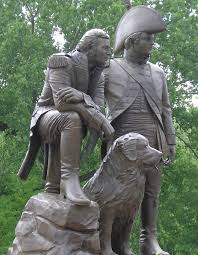
Statue of William Clark, Meriwether Lewis and Seaman the dog that accompanied the Corps to the Pacific. Located in City of St. Charles Riverfront Park.
The Corps would await Meriwether Lewis who was in St. Louis attending to some business. Everyone would enjoy themselves for one last time in the village, waiting for the expedition to begin.
Visit the Lewis and Clark Boathouse and museum that shares the story of the Lewis and Clark Expedition, and houses reproductions of the Keelboat and the white and red pirogues. For more information see https://www.lewisandclarkboathouse.org/
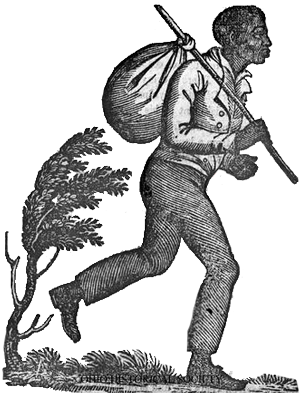
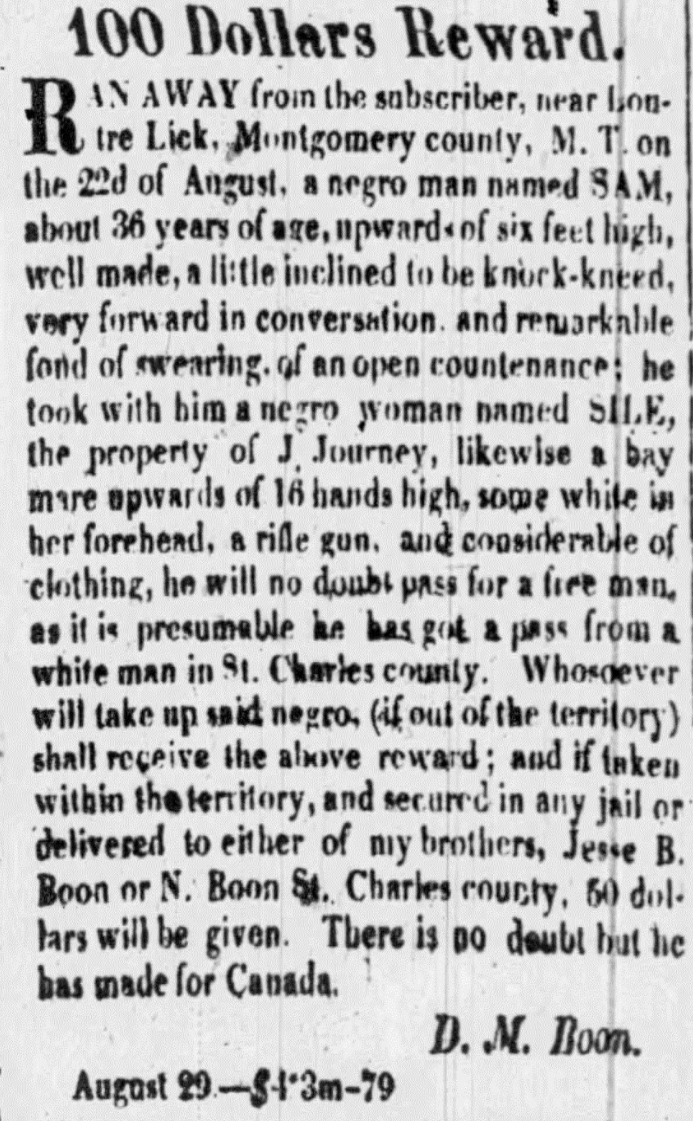
On the 22nd of August in 1819, an enslaved man named Sam, who was about 36 years old, ran away from his enslaver, Daniel Morgan Boone, son of the famous trailblazer Daniel Boone. Daniel Morgan quickly advertised that a reward of $100 would be given if Sam was secured in any jail, out of the territory; or $50 if captured and returned to either of his brothers, Nathan or Jesse Boone.
Sam is described as about six feet tall, “well made” and “a little inclined to be knock-kneed” and “very forward in conversation”. He is “remarkable fond of swearing” too. He took with him a young woman named “Sile” who was enslaved by James Journey. He also managed to take a horse, a bay mare upwards of 16 hands high, who had a patch of white on her forehead, a rifle, and quite a bit of clothing. This will make him appear to be a free man to others. It is presumed that he got a pass from someone, anxious to help him reach freedom. There is no doubt that he is headed for Canada.
According to the newspaper, Daniel Morgan was living at Loutre Lick, along the Missouri River. His brother Nathan had built a large stone home, along the Femme Osage Creek further east toward St. Louis. Daniel Morgan Boone’s brother Jesse had established an inn, northwest of him, along the Boone’s Lick Trail, at Mineola Springs. The pioneer Daniel Boone had arrived in the territory in 1799, and by 1819 the trailblazer was often spending time at his daughter Jemima Boone, wife of Flanders Callaway’s home near Marthasville. His wife Rebecca Bryan had died six years earlier and was buried near Jemima’s home.
George Caleb Bingham
In 1812, Missouri had been organized as a territory, with St. Charles one of the five original counties. The reward had been posted in a St. Louis newspaper known as the Missouri Gazette and Public Advertiser which began in 1818 and was published by Joseph Charless (1772-1834). In 1819, a census reported that in St. Charles County 981 people were living here with 124 slaves and five free blacks. Today, that $100 reward would be the same as $2,332.88 in today’s money. The advertisement had cost Daniel Morgan $4 for placement in the newspaper for the next three months.
In 1819, residents of the Missouri Territory petitioned the U.S. Congress for statehood. Its’ residents were settlers from Virginia and Kentucky, who had brought their enslaved property with them, and wanted to continue the practice. A debate had ensued when Representative James Tallmadge proposed as a condition of Missouri’s statehood that “no further slaves could be imported into the state and all children born after Missouri’s admission to the Union shall be born free.” One can only imagine what a difference this would have made in Missouri’s history. Tallmadge’s plan did set out a plan for gradual emancipation in Missouri, that would continue to evolve and light the fuse for the Civil War. It would take the Missouri Compromise, set out by Speaker of the House Henry Clay of Kentucky, to bring the state in to the Union, as a slave state. Missouri would achieve statehood on August 10, 1821. And even after Lincoln’s Emancipation Proclamation, of January 1, 1863, it would not be until January 11, 1865, that the enslaved people of Missouri would be free.
A network to freedom, otherwise known as the Underground Railroad, developed to help those like Sam. This wasn’t an actual railroad, but a close-knit group of people who chose to help the enslaved reach freedom. Secretive, covert, undercover, this was a network of people cloaked and often disguised, that were willing to risk their own lives to help. They provided concealed, hidden, and secret hiding places, for those making their way to safety, and the ultimate achievement of freedom. German immigrants had filled Missouri’s valleys by the time of the Civil War, and having come to America in search of greater freedom’s themselves, were often willing take such necessary risks.
Missouri Gazette and Public Advertiser Sept. 15, 1819Library of Congress G4050 1814 .C31 TIL






 ST. CHARLES COUNTY HISTORY
You must be logged in to post a comment.