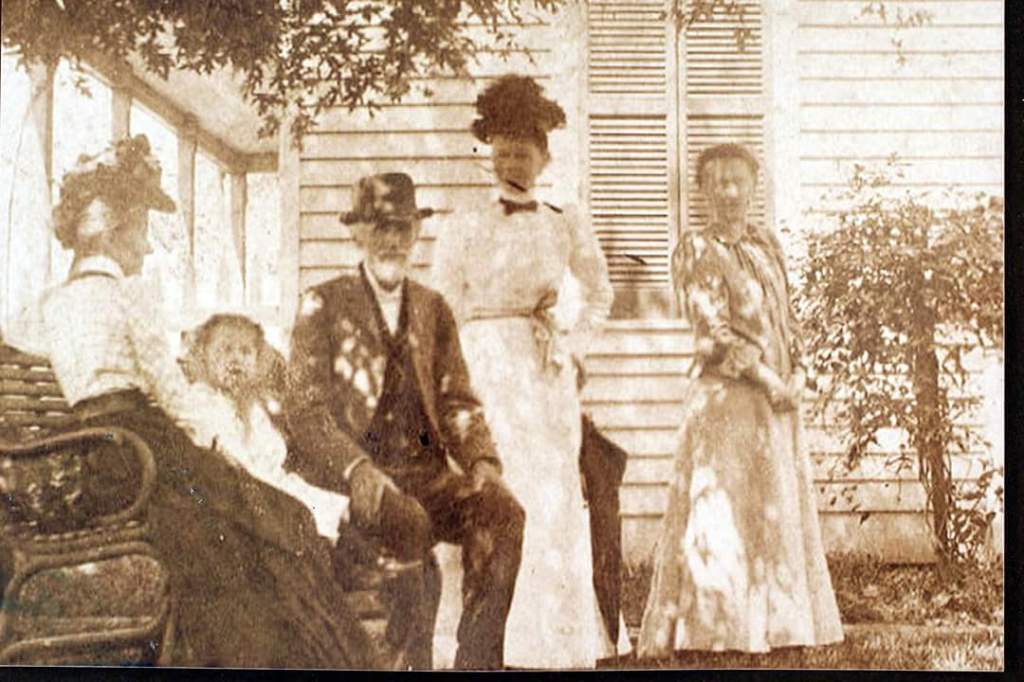
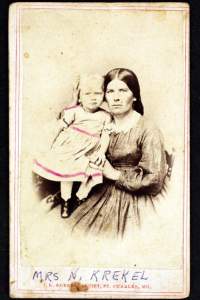
Bertha Krekel was born in O’Fallon, on December 25, 1859, she was the second child of Nicholas Krekel, who together with his brother Arnold Krekel, had founded the town on August 6, 1856. Her father Nicholas had been born in Germany on August 30, 1825 and had emigrated with his family at the age of seven. His father had brought his family to America in 1832 and had settled in southwestern St. Charles County, near Dutzow. Nicholas purchased the land where he would build a home for his wife, and live together after their marriage on August 15, 1857 from his brother Arnold. By the time Bertha was born, O’Fallon had its’ own Post Office and Train Depot, which her father managed.

Bertha spent her entire life in that same house on Main Street (today’s Cleo Bridal Shop) where she would be surrounded by her family and in the center of the community. She and her father were very close. Her sister Mary would marry William Westhoff on October 13, 1892 and after their father’s death on February 6, 1910 Bertha would continue to live in what became William and Mary’s home, the Westhoff place. A real hub of the community, it was just across the street from the Westhoff Mercantile. There the young lady, who never married, took a liking to writing about the bustling town’s events, and wrote about the daily life and its’ eventual history. As the City had a newspaper, and her uncle Arnold Krekel was also involved with two of St. Charles’ newspapers, there was an easy outlet for the young muse’s talents. She wrote under a pen name, which was a custom at that time – of Clio – the muse of history, who inspired the development of liberal and fine arts in ancient Greece.
Here are a few newspaper clippings in Bertha Krekel’s scrapbook that bring the history of O’Fallon to life.
June 1912 History of O’Fallon as written by a Ms. Keithly
This was written by Miss Hortense Keithly and read at the graduating exercise of the O’Fallon High School.
When the railroad came through this portion of the country O’Fallon began its growth as a town. Previous to that event, Cottleville and Flint Hill, with the exception of St. Charles had been the most rapidly growing towns in this county.
The country surrounding the site of the present town was occupied by a a few very small trading places among which was Wellsburgen the Salt River Road, about 2 ½ mile south of the present site of St. Paul. It consisted of two buildings, one of which was occupied by a saloon, store, post office and a residence. The other contained a blacksmith shop. There was another store also on the Salt River Road, where Mrs. Anton F. Orf now lives, about ½ mile west of Audrain Bridge, where Dardenne is now situated, there stood a shop which contained what was know as Nailer’s Store.
While Cottleville and Flint Hill were increasing in size, the site of O’Fallon was covered with timber, excepting a small area where the convent now stands and a plot surrounding the only house in the near vicinity. This house stood on the south side of the railroad and east of Main Street, just back of where Talleur’s baker shop and Ahren’s saloon are at present. It was occupied and owned by Mr. Henry Ernst. One of the most interesting and peculiar facts known concerning the physical features of the area occupied by the town, is that at the time Mr. Ernst lived here there was a spring near his residence. The portion of the country on the north side of where the railroad now is and easrt [sic] of Main Street was owned by Mr. Joseph Boegel; that on the same side of the railroad track, west of Main Street, belonged to Mr. Arnold Krekel.
The part on the south side of the railroad track and east of Main Street was the property of Mr. Henry Ernst and the remaining portion was owned by Mr. Joseph Trevy.
The North Missouri Railroad now known as the Wasbash was located in 1855. It was completed as far as Peruque Bridge in 1858 and the first train was run over the road as far as the bridge in the summer of that year.
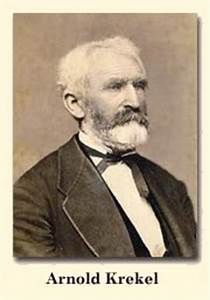
During the year 1855, Arnold Krekel, who was a prominent St. Charles County Attorney, who later became a United States Judge for the West Division of Missouri, laid out the original town of O’Fallon on the north side of the railroad and west of the north projection of Main Street.
The town was named for John J. O’Fallon, a prominent business man of the city of St. Louis at that time. In 1856 Nicholas Krekel, the brother of Arnold Krekel built the first house and did the first business as a merchant and Post-master in the town and was also the first agent for the railroad here. Also about this time, Mr. McIntosh built a one story house where Mr. Peter Saali’s hotel stands at present. A few years later this property was bought by Love and Callaway who built part of the house and saloon, where the residence of Henry Ahrens is at present.
In 1858 Ward & Ward [edited by crossing out] built a store just north of where the Werner Millinery Store stands. In 1854 Dr Woods built the residence owned by Mr Charley Himmelsbach. Later Dr. W.C. Williams bought the house built by Dr. Woods. He used it as his residence until he built the residence now owned by Mrs. Susie Johns. It was Dr. W.C. Williams and Dr. J. C. Edwards who bought the property previously owned by Mr. Henry Ernst and platted the part of the town of O’Fallon that lies east of Main Street and south of the Railroad.They presented the lot now now occupied by the Westhoff Grain & Mercantile Co. building to Mr. rufus Gamble on the condition tha eh build a brick house upon it. It was the first brick house in the town. The ground floor was used as a store; the second floor as a Masonic Lodge Room. The house is now a part of the Westhoff Grain & Mercantile Co.
When O’Fallon was first settled there was no public road leading to or from the town. There were simply private or by-roads. For many years the road ran in front of Mr. Krekel’s business place which is now owned and occupied by Mr. Wm. Westhoff crossed the railroad west of where the present depot now stands, came into what is now Main Street in front of where Ward & Ward’s Store stood. It faced north, and ran south-westerly across what are now fields to the Mexico Road, where Woodlawn now stands. Main Street is now a part of the public road which is now a part of the public road which was afterwards located extending north to the Salt River Road and south to the Mexico Road.
This is from a book of newspaper clippings kept by the Krekel family. Bertha must have been quite the historian, as she took it upon herself to freely editorialize facts published by Miss Keithly, and are what are shared in this story. Otherwise, it is exactly the way it was published in June of 1912, and shares quite a bit of history by someone whose family played a prominent role in the town of O’Fallon when it was young.
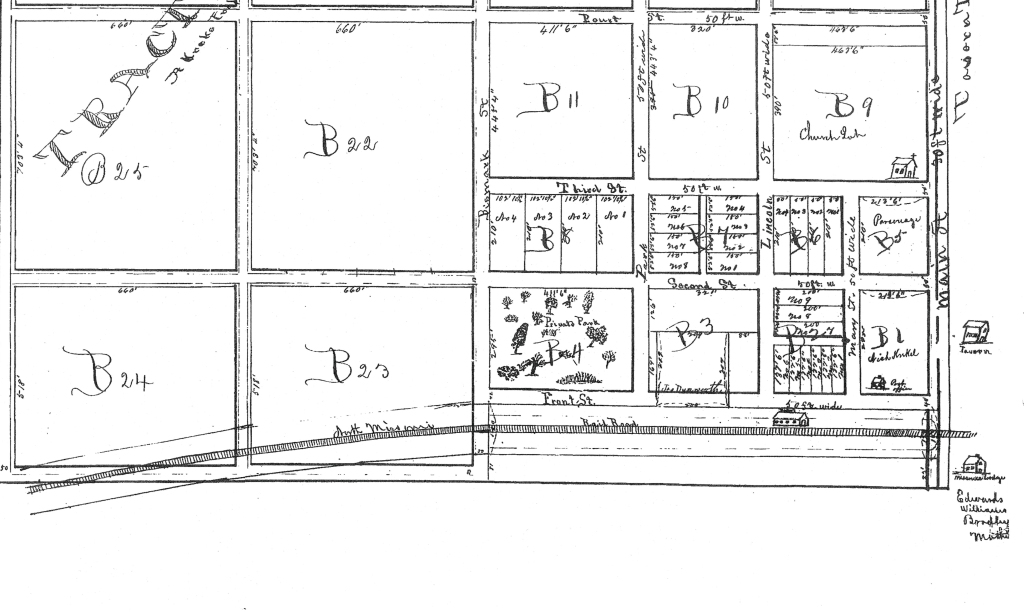
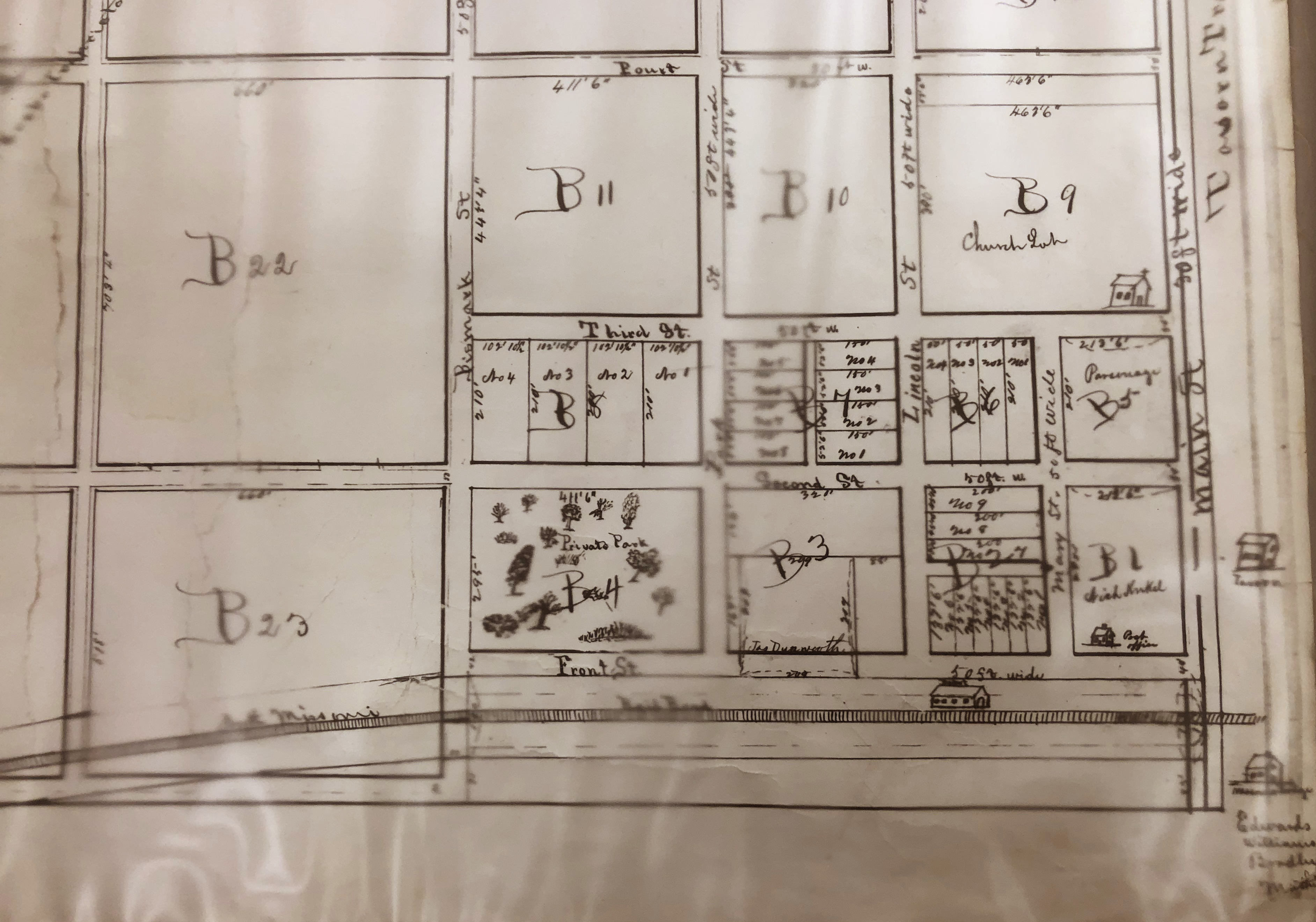
Original Plat of the Town of O’Fallon, Missouri
Note: The map is looking north, and all property shown on this plat lies WEST of MAIN STREET which is Hwy. K, which is the right hand border of where the town originally ended. (That is NOT Sonderen.)


 ST. CHARLES COUNTY HISTORY
You must be logged in to post a comment.