ST. CHARLES COUNTY HISTORY

By Dorris Keeven-Franke

  • The Alexander house in Dardenne Prairie

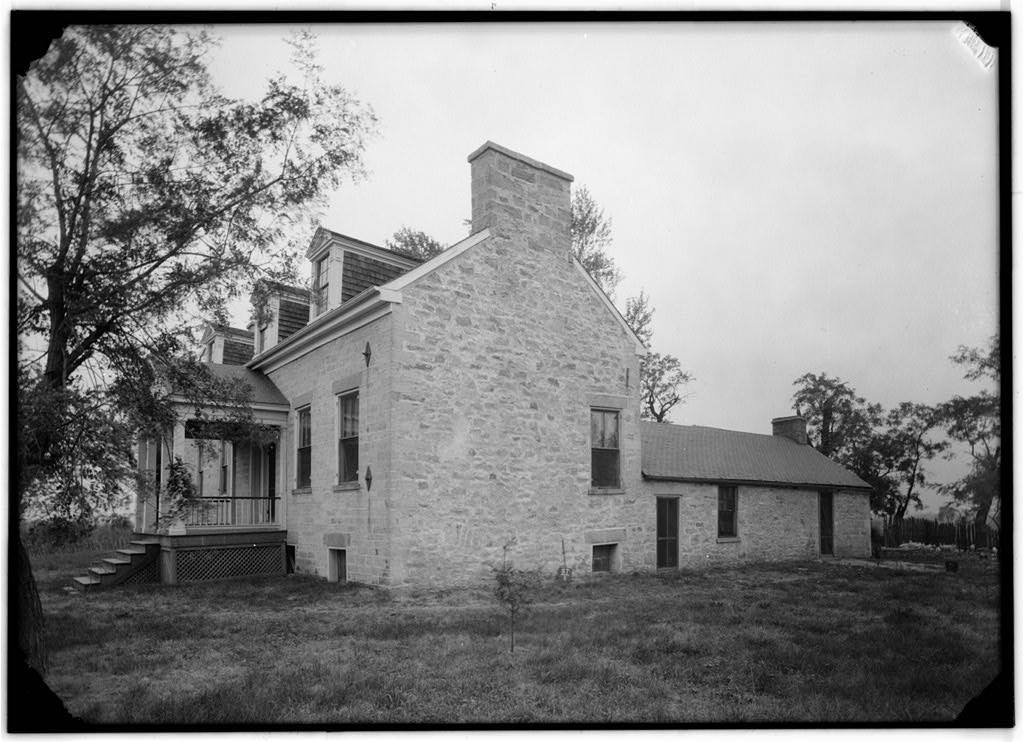
    In 1829, James Alexander (1785-1835) would find Missouri to be a promised land, full of opportunities. He and his wife, the former Nancy McCluer (1791-1833) had come with her brother Dr. Robert McCluer (1792-1834), arrived in October, and immediately joined the Dardenne Presbyterian Church on the Boone’s Lick Road. They had left Virginia, according to their cousin William Campbell, that August with five children, but when they arrived had two sons, John and William, and two daughters, Agnes Jane and Sarah Elizabeth, all under the age of seven. They also brought five enslaved individuals, Archer, his wife Louisa, their son James, Louisa’s sister and mother. James would immediately purchase property near the McCluers and begin to build a beautiful stone home, while living in a log cabin built by a previous owner.
    Library of Congress

    James Alexander employed two stonemasons from Ireland named Pourie, that were nephews of the Millingtons who had built Stone Row in St. Charles on Main Street. Archer, who knew brickmaking and masonry techniques would work with them, as overseer of the other enslaved workers. Other families nearby, the Bates, McCluers, Naylors, Gills and Pitmans would lease their enslaved to help with the building as well. Archer was a talented carver and is said to have done some of the interior carpentry.
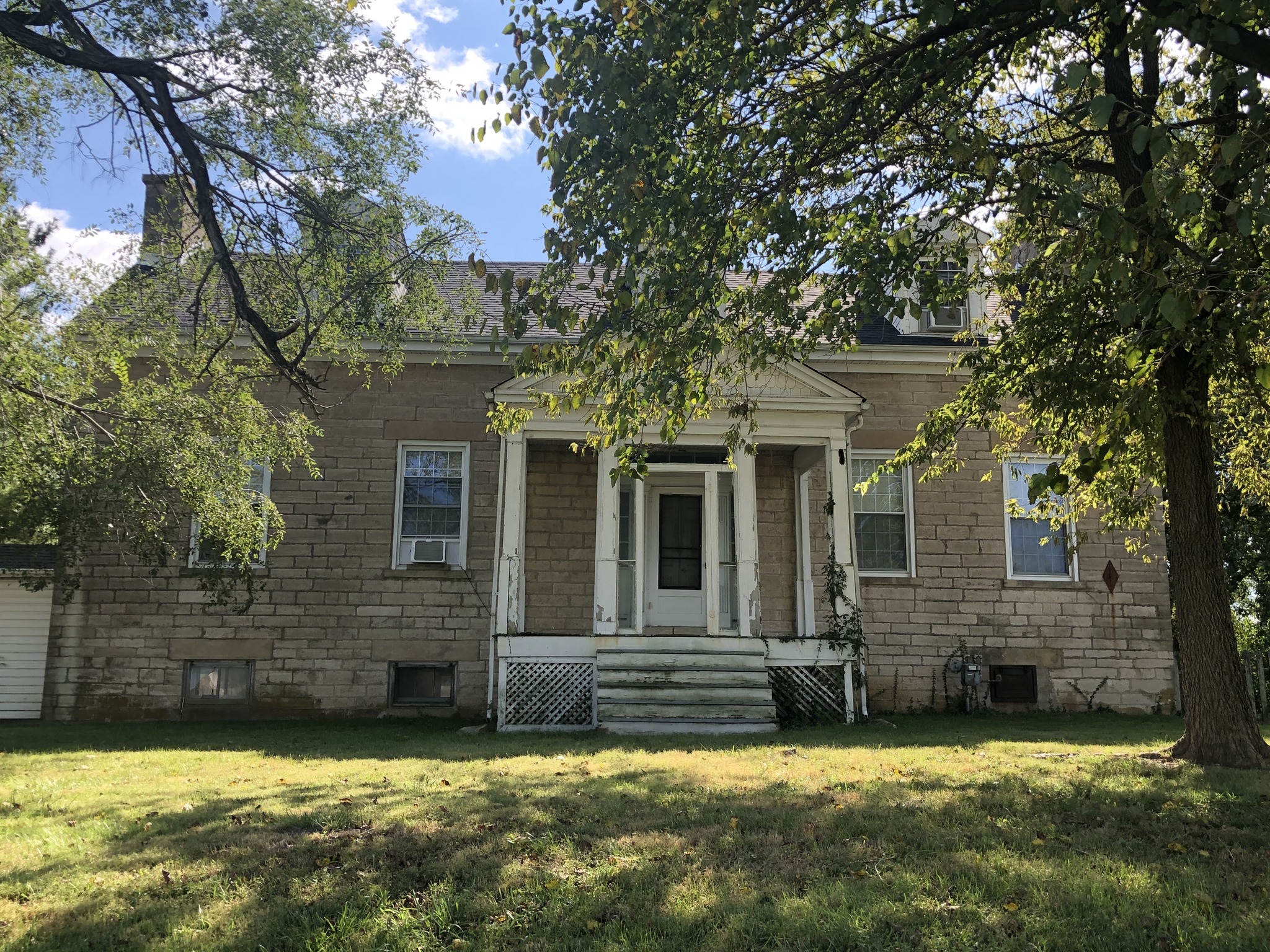
    Photo by Dorris Keeven-Franke

    By 1834, the stone house would be complete, and James Alexander was appointed the area’s U.S. Postmaster of what was designated as Stockland. The region was growing rapidly and being located directly on the Boone’s Lick Road was a great advantage. Nearby Cottleville a few miles to the east was growing as well with David Pitman’s addition. Just to the west of James Alexander’s was John Gill’s mill, and then came John Naylor’s store, before the huge Bates plantation. The area was also experiencing growth because a wave of German immigrants had arrived in the area that summer, with some settling in Cottleville, St. Paul (Dog Prairie) and creating the town of Hamburg, near Howell, just south of Dardenne along the Missouri River. However with all of this growth also came cholera, and it grew to epidemic proportions. Nancy Alexander would die first, and then Dr. McCluer and his littlest son. They were buried in the Old Dardenne Presbyterian cemetery.
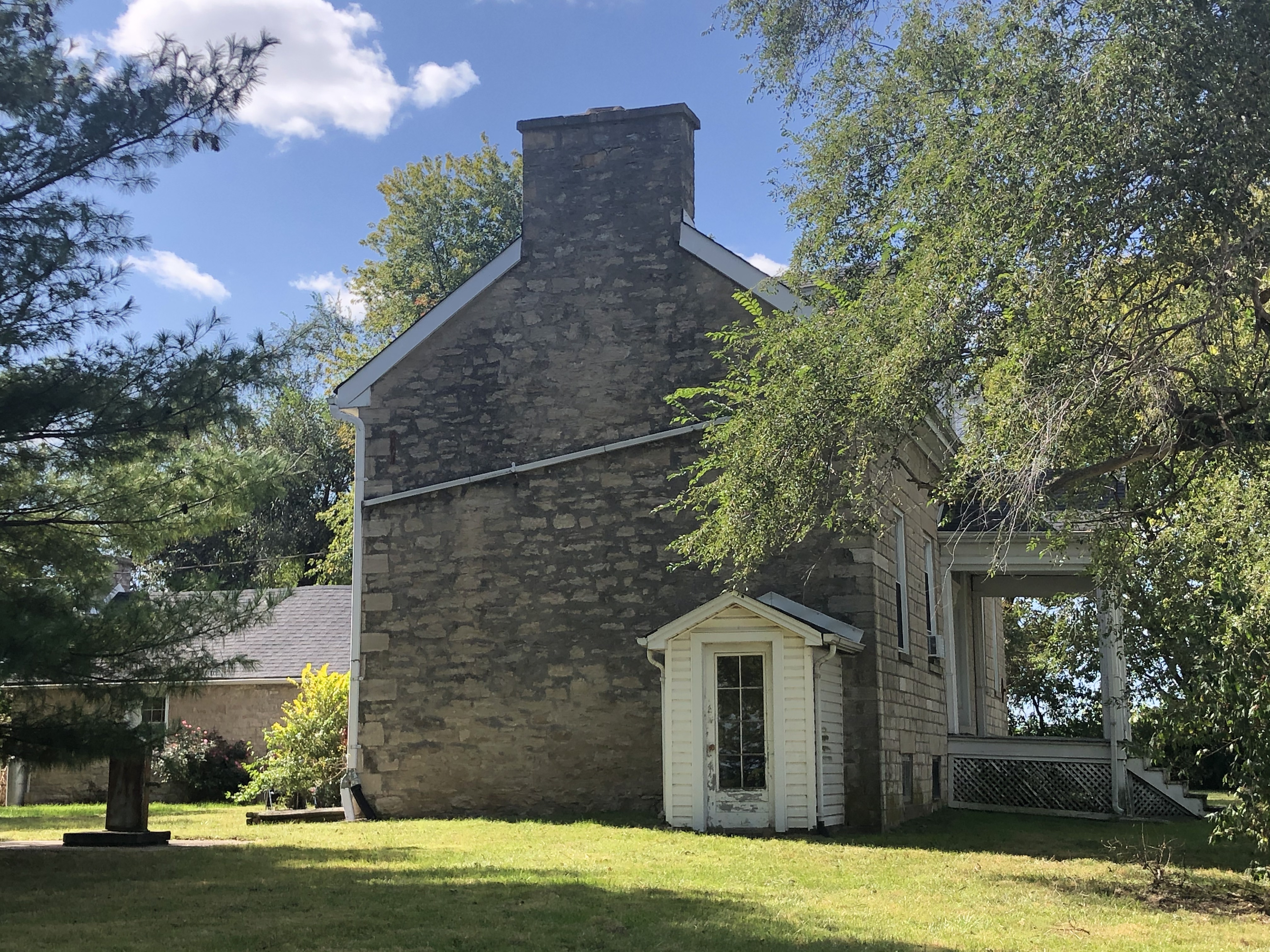
    Photo by Dorris Keeven-Franke

    By 1835, James Alexander was not only the Postmaster, but the stagecoaches that travelled the Boone’s Lick Road also stopped at “Alexanders”! Then more tragedy hit. James Alexander succumbed to the cholera epidemic that was sweeping the valleys, indiscriminately, black, white, young or old, including the German immigrants. James Alexander left four orphaned children behind, and several enslaved people. James Alexander assigned his cousin William Campbell, an attorney, to be his Executor, leaving instructions that neither the enslaved nor the farm were to be sold. He became their agent. They were to be leased to others and all of the income generated was to be sent to Virginia, to support his children. Campbell would take the orphaned children back to their Aunt’s home in Virginia to live with her and her husband.
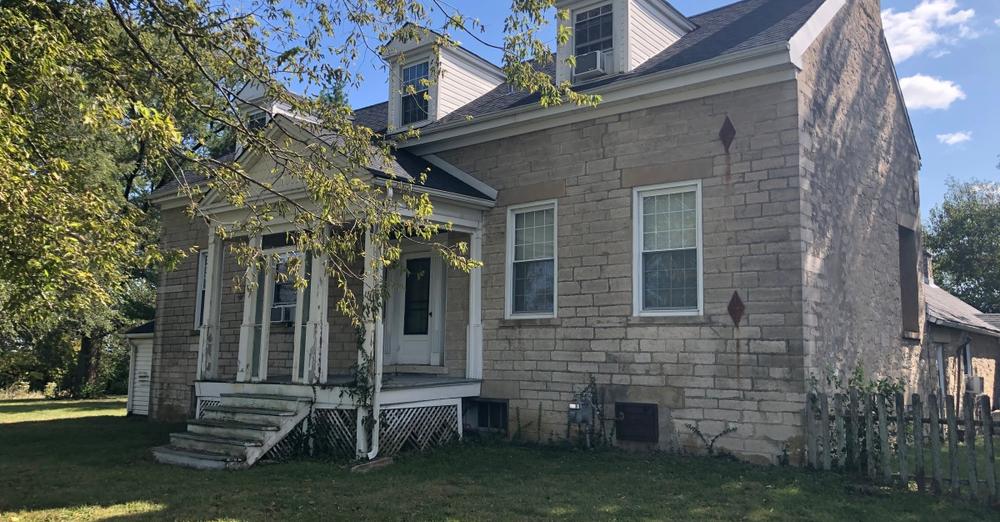
    Photo by Dorris Keeven-Franke

    The enslaved continued to live on the farm and they were leased out to others, generating a huge annual income for many many years. Archer Alexander and his wife Louisa would have ten children over those years as well. They are the great-great-great grandparents of Muhammad Ali. In 2019, several members of the family were able to visit the home as St. Louis Public Radio followed their journey to learn their family history…. You can listen to that here… https://archeralexander.blog/louisville-family-learns-about-their-ties/
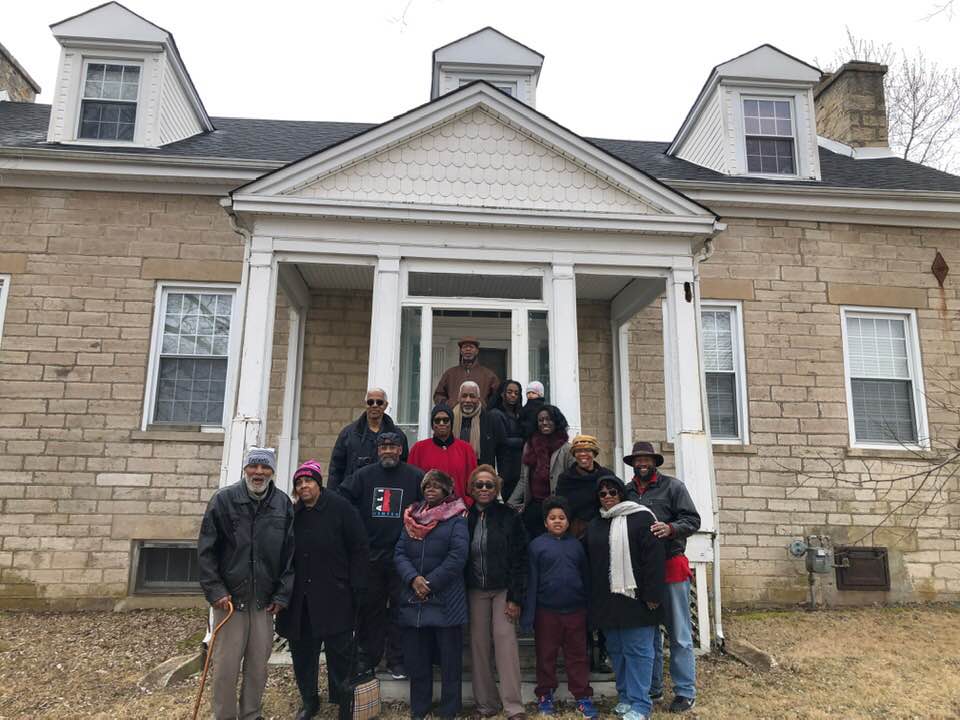
    Photo by Dorris Keeven-Franke

    Over the years the house, which sits on the Boone’s Lick Road in St. Charles County has often been known as Captain Campbell’s house (and he did live there at one time) as dubbed by historian Edna McElhiney Olson, or Twin Chimneys because of another nearby similar house that also had Twin Chimneys. Let’s give it its rightful name now, the Alexander house at Dardenne. It still stands proud and tall, one of the oldest homes in St. Charles County, a private home, on Hwy N, just west of the intersection with Hwy K, just past all the shopping centers and highways.

    For more stories by Dorris Keeven-Franke like this…

  • From Virginia to Missouri

    I started from Lexington, Virginia on a journey to the state of Missouri. My own object in going to that remote section of the Union was to seek a place where I might obtain an honest livelihood by the practice of law. I travel in company with four families containing about fifty individuals, white and black.” On this day in 1829, fifty people, would leave everything behind to start a new life. The families of Alexander, McCluer, and Wilson would have their enslaved families with them, that would make up over half of the caravan. Jacob Icenhauer, a German from Pennsylvania, had also joined the group, but didn’t own any slaves.Journal of William Campbell, Washington and Lee University Library

    Part of this caravan was Archer Alexander, owned by James Alexander, whose father had been sold a few years back, because he was uppity. With Archer was his wife Louisa, who had been inherited by James’ wife Nancy McCluer, when her father John McCluer, died a few years back. With them were their children, as Louisa had just given birth to their son Wesley Alexander, and was the wet nurse for the Alexander’s youngest of five children.

    This story, of Scotch-Irish Presbyterians, making their way to the frontier for a new beginning, is one of the thousands that would come from Virginia at that time. Missouri, had entered the Union in 1821, and was a fast growing slave state carved out of the Louisiana Territory with the Missouri Compromise. With this link, you can follow their journey, day by day, with entries from the Journal of William Campbell, son of Samuel LeGrand Campbell.

    You won’t hear the story of those who were enslaved making the trek, but they are there. They feed and water the cattle and the horses, they set up the tents, gather the firewood, cook the meals, and tend the children. They don’t rest when the caravan stops. 

    To follow Archer’s journey DAY BY DAYbegin here https://archeralexander.blog/2021/08/20/from-virginia-to-missouri/ You can follow the entire journey as each entry is linked on my archeralexander.blog

    This is a true story of St. Charles history. For more stories like this about St Charles subscribe to this blog below….

  • Benjamin Oglesby

    Category: People

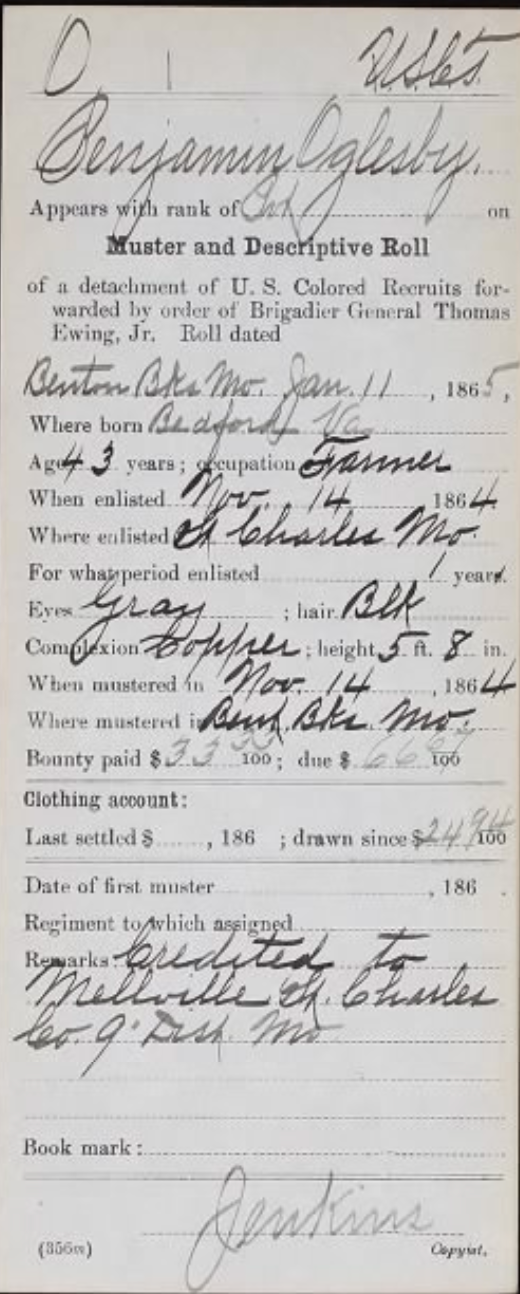
    Many of St. Charles County’s enslaved men would resist enslavement and risk everything to enlist in the U.S. Colored Troops. Leaving families behind, they used the network to freedom known as the Underground Railroad to enlist in the U.S Colored Troops during the Civil War. One man named Benjamin Oglesby was born in Bedford, Virginia in about 1821 while his mother’s enslaver was Marshall Bird. Benjamin was brought to Missouri by Bird around 1830 and according to St. Charles County historian Ben Gall “settled in property that sits to the southeast of the park along Meyer Road, in Sections 18 and 19 of Township 47 Range 1 East. During this time, Oglesby lived among seven other enslaved people while working the 260-acre farm. On this farm, he worked to cultivate corn, wheat, and tobacco, the last of which was their primary crop, producing 7000 pounds in 1860 alone.“ He would jump the broom and take a wife named Martha Bird, who he called Patsy, and together they would have eight children, Dora, Mary, Samuel, Sarah, Sophia, Oska, Albert and Belle. On November 14, he and several other St. Charles County slaves had left their owners and enlisted in the U. S. Colored Troops at George Senden’s store on Main Street. Soon after Oglesby was formally mustered into Company D as a Private of the 56th Infantry of the Union’s U.S. Colored Troops, at the age of 43 at Benton Barracks. His enrollment card says he is “copper-skinned, had grey eyes and black hair and was 5 feet 8 inches tall.

    His Regiment, the 56th U.S. C.T. would see action in 1864 at Indian Bay on April 13, at Muffleton Lodge on June 29, they were in charge of operations in Arkansas July 1-31. They then saw action at Wallace’s Ferry and Big Creek on July 26, 1864. Their expeditions took them from Helena up the White River from August 29 till September 3. Another expedition would take them from Helena to Friar’s Point, Mississippi, on February 19-22, 1865.  They then had post and garrison duty at Helena, Arkansas till February of 1865. After the war ended, they had duty at Helena and other points in Arkansas till September 1866. The entire regiment was finally completely mustered out on September 15, 1866. The Regiment lost four Officers and twenty-one enlisted men who were killed or mortally wounded and they lost two Officers and 647 Enlisted men by disease.”  Oglesby’s Muster Card indicated he was honorably discharged on November 13, 1865, at Helena, Arkansas, and was still owed $66 of his $100 enlistment bounty.

    When he returned home, he and Patsy would rent a house and live south of Foristell, near Painter’s Store on the Boone’s Lick Road (Hwy N) where it crosses into Warren County (Hwy O today). Benjamin and Patsy would have four more children, Charles, Walter, Mount and Allie. According to Ben Gall “On March 2, 1871, Benjamin Oglesby purchased the property located along Meyer Road for $2000 from William Haggemann, who may have been a German immigrant. It appears that he acquired the funds for this land through a Deed of Trust, which they entered into with Henry Reinecke in March 1871. They paid off the property on March 14, 1877.

    That September, on the 23rd, in 1871, Benjamin’s son-in-law Jackson Lockett, along with Austin Pringle, Nathaniel Abington, Smith Ball, David Bird, Thomas McClean, Mark Robinson, Clayborn Richards, and Martin Boyd would become the Trustees for the Smith Chapel A.M.E. Church and Cemetery at Snow Hill. There the one-acre of land would have one-third dedicated to a black school, named Douglass after Frederick Douglass. The small one-room schoolhouse would be attended by area children until 1951 at least. The school has been moved to Ogelsby Park, where the Ogelsby family once lived, and a mile from the cemetery. The cemetery is less than a 1/4 mile north of Interstate 70 near Foristell.

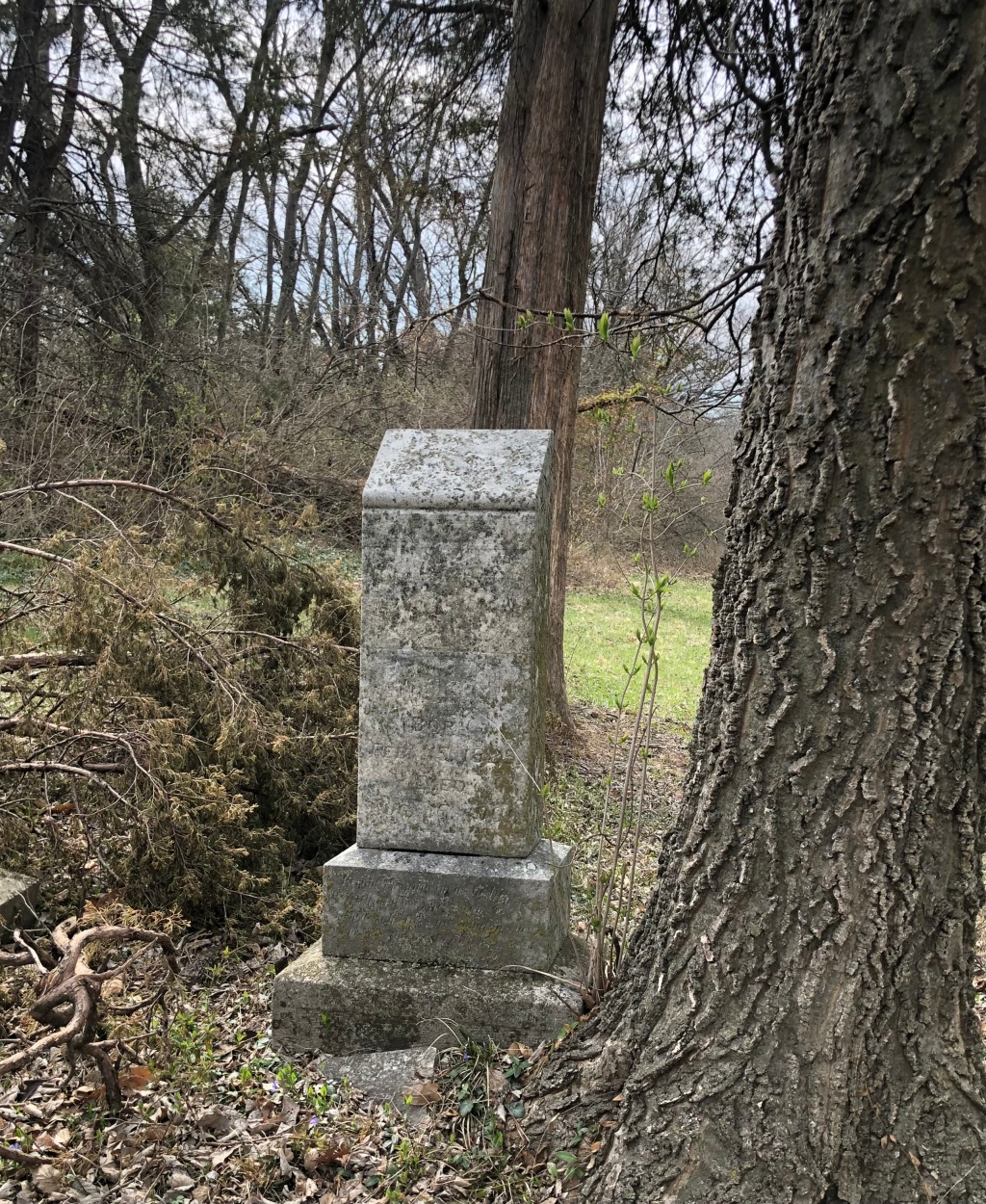
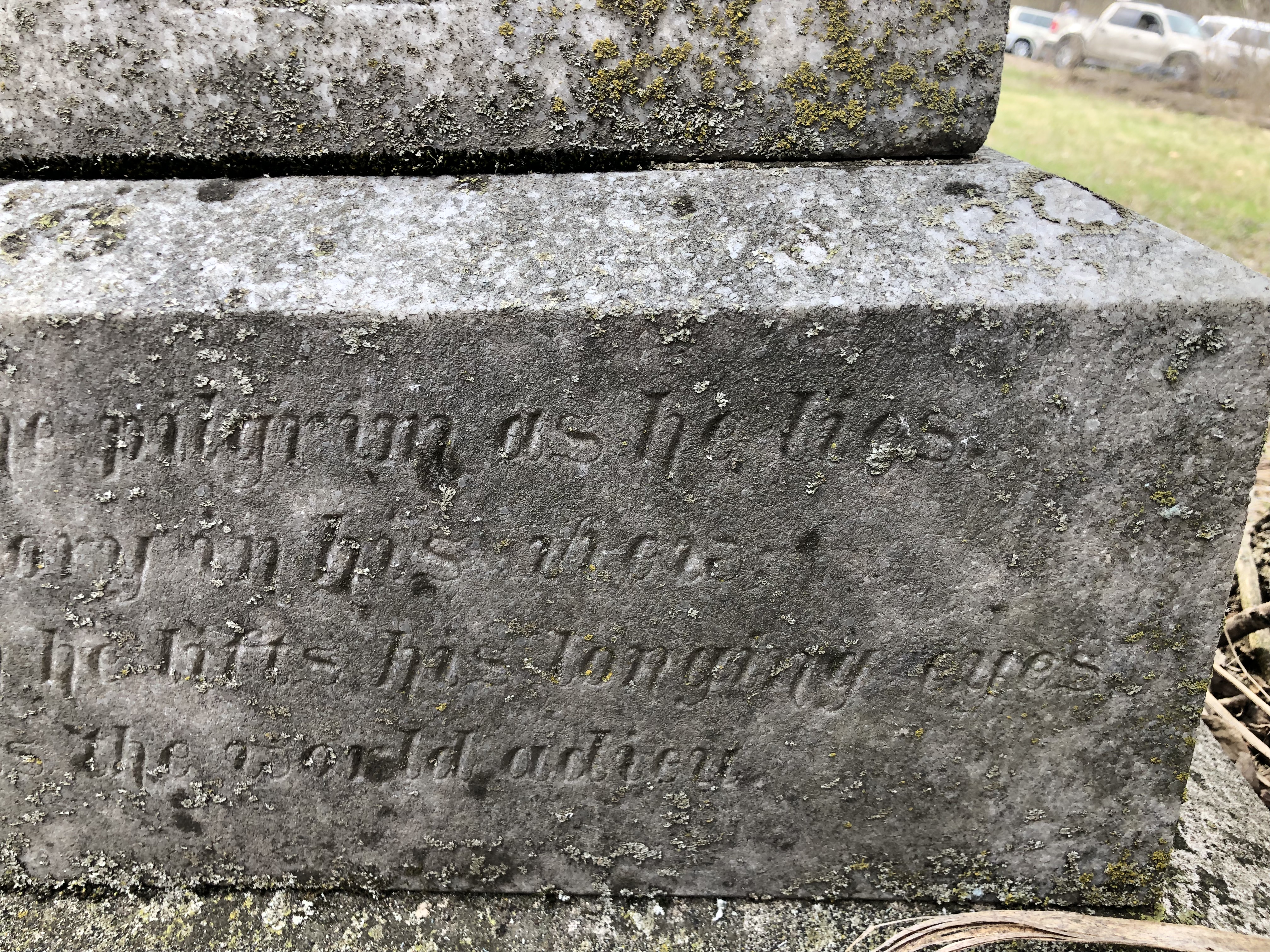
    Benjamin’s wife of over forty years, Patsy, would pass away on the 12th of August 1888 and be buried at Smith Chapel Cemetery at age 58 years old. The family would attend their church, teach their children, and bury their family all at Smith Chapel. Then on the 15th of August 1901, Benjamin Oglesby would join Patsy in the cemetery. There his stone reads Behold the pilgrim as he lies, With glory in his view, To heaven he lifts a longing view, And bids the world Adieu.

    Smith Chapel Cemetery is on the National Underground Railroad Network to Freedom.

    For more information about Smith Chapel Cemetery see https://smithchapelcemetery.com/