History happens. All stories, especially the difficult ones, need to be heard. Award winning author, a public historian, professional genealogist, and International speaker. Member of the Missouri Speakers Bureau and the National Underground Railroad Network to Freedom.
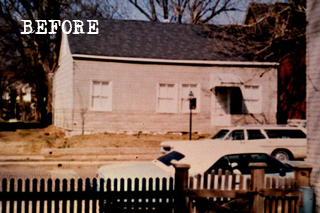
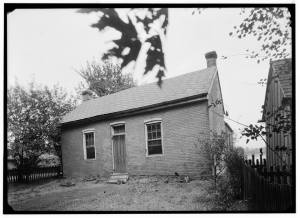
Circa 1799 – This early building on Block 25 was said to be built by a Frenchman born in Quebec Toussaint Hyancinthe Cerre (Serre) and so it is referred to as “the French House”. Cerre was related to the families of Chouteau and Soulard in St. Louis. A wealthy French Canadian, Cerre had married into another wealthy French family, that of Marie Roy, whose family had come fom Kaskaskia to San Carlos in 1796. She would die in 1802, while we were still under the control of Spain. She would be buried in the early San Carlos de Borremeo Church cemetery north of here on Main. This is most likely the earliest log building still standing on Main Street yet today.
For more stories of St. Charles County History subscribe to this blog (its free!)
Here is more about Louis Blanchette (sometimes found as Blanchet or Blanchett) and the earliest settlement north of the Missouri River known as Saint Charles, originally known and often referred to as Les Petite Côtes or The Little Hills. Contemporaries of Louis Blanchette[1] (sometimes Blanchet) stated that he and his wife, who he took from the Osage named Tichomchanga, and who later took the name Angelique[2] had settled along a spring fed creek in 1769. At that time it was in Spanish territory that had been French, and in what was referred to as Illinois territory within the limits of the Spanish government’s holdings [3]. The village was situated at the foot of a range of small hills, often referred to as La Mamelles (French for breast) sufficiently high to protect it from the summertime overflows of the Missouri.
The Census of 1787 of San Carlos or St. Charles… contains the following information about Blanchette “Juan Bapta Blanchet, aged 51; Maria Su Mujer; 48, Baptiste Blanchette 24; Maria Blanchette 21” In addition to these his household contained, one carpenter, one huntsman and four laborers. Houck also quotes Auguste Chouteau, as noted in Hunt’s Minutes Book 1, page 127 saying “les Petites Cotes was established by Blanchette.” Houck also established where Blanchette lived “the lot upon which the first house being the square now numbered 19 bounded on the south by McDonald [McDonough], west by Main, east by Missouri [River] and north by Water streets, and from this we infer that Blanchette must have first erected his hut on this block when he made a settlement at what is now St. Charles.” However, it is important to remember that Blanchette’s settlement was nearly fifty years prior to the establishment of the City’s “lot” blocks.
Historian Kate Gregg’s research differed a little as she stated: The first settler in St. Charles, and probably the first one to build a mill north of the Missouri was Louis Blanchette, who came to live at the foot of the river bluffs in 1769, and called them Les Petites Cotes or Little Hills. He established government buildings for the Spanish and a home for himself on what is now Block 20 of St. Charles; and on the stream that runs through it, the very water-course that the Boonslick [Boone’s Lick] Road later followed to the top of the hill, he established what appears to have been the first grist mill. Whatever hauling there may have been to and from his mill must have been, for the most part, between the mill and the village commons lying to the north of the town in the rich prairie; though there is every reason to believe that Blanchette and his neighbors made some kind of a road in getting from the southern part of the village where Blanchette lived, to the less fertile commons lying toward the west. The natural road between the mill and the two commons at the top of the hill was along the little stream which the Boonslick [Boone’s Lick] Road later followed. In 1789, Louis Blanchette, with only four more years to live, sold his land in the southern part of the village to John Coontz, a German,… and he too erected a grist mill on Blanchette Creek, building a dam for it on what is now known as Block 79. Romain Dufreine, testifiying before Theodore Hunt, Land Commissioner, on May 7, 1825, swore that John Coontz had built his mill on this square thirty years before, i. e., in 1795, and had continued to occupy the land until he moved to the Dardenne ten or twelve years later.[4]
Auguste Chouteau made the first survey of the village, under order of the Spanish authorities, but the map of the village, has not been preserved, according to Gabriel La Trail, one of the oldest residents of St. Charles in 1824, who said “he assisted in the survey”. He was one of the principal witnesses before Commissioner Hunt testifying as to the ownership and occupancy of many of the lots of the village. Another who helped with the survey was Louis Barrada the Senior.
In 1787 the population was said to be eighty families to one hundred families. “The houses, about one hundred in number, in which the four hundred fifty inhabitants lived, were scattered along a single street about one mile long”[5] Even though ‘les Petite Côtes’ (the Little Hills), or San Carlos (Saint Charles) belonged to the Spanish, its inhabitants were mainly French- Canadians. Their occupations were fur trappers, traders and boatmen. They interacted with the Native Americans on a daily basis, intermarried with them, and their cultures combined not clashed. Outsiders considered them poor and indolent, but those that visited and got to know them insisted this was not true. It must have been a picturesque early settlement along the riverfront with the hillsides behind them rising and creating a backdrop for the early log houses, built in the early French style.
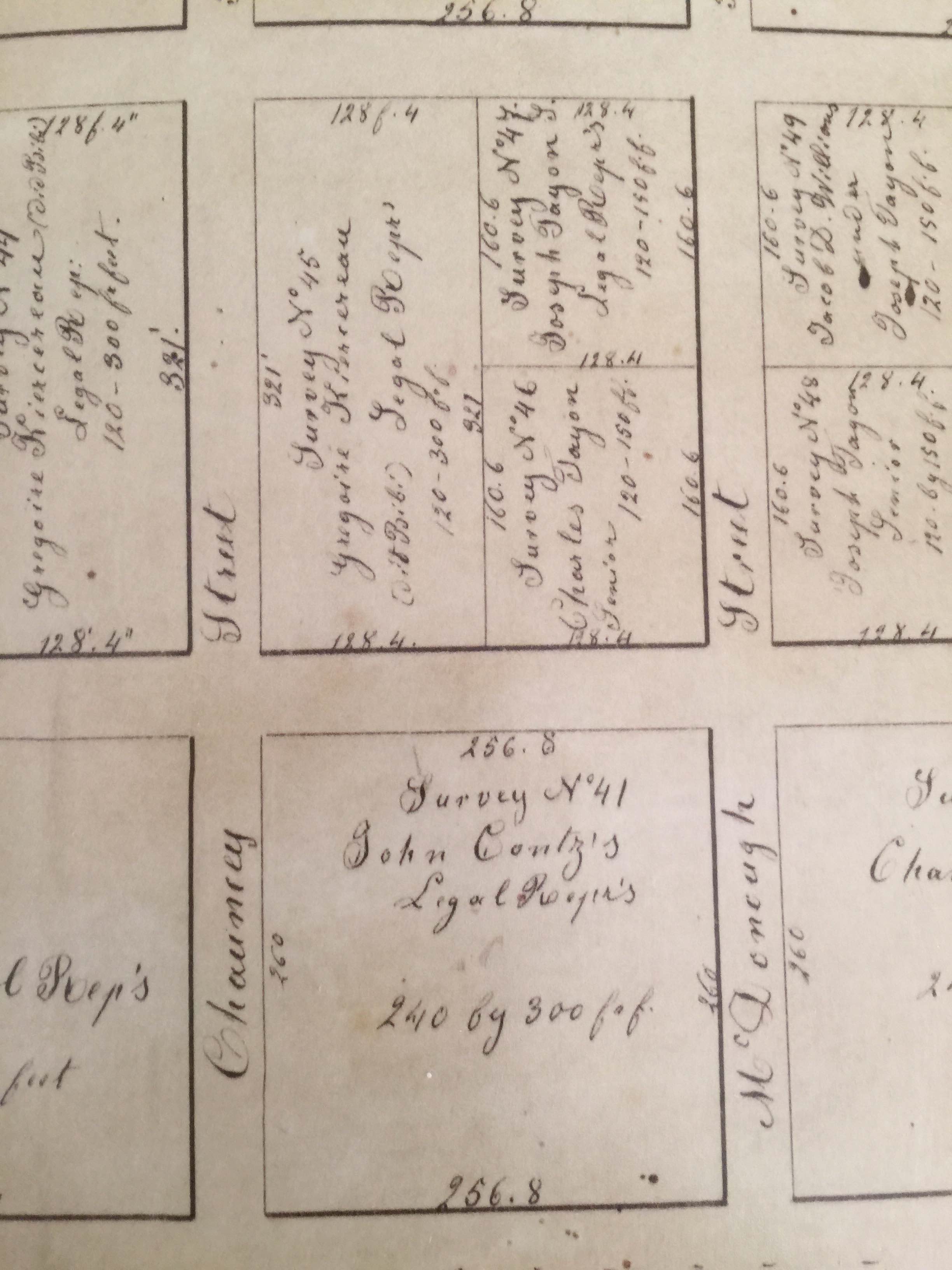
At the bottom is Block 20, showing John Coontz as he still owned it in 1817. From the original plat of St. Charles.
ENDNOTES
[1] Louis Blanchette was a native of the Diocese of Quebec Canada, and a son of Pierre Blanchet and Mary Gensereau.
[2] Ehlmann, Steve, Crossroads: A History of St. Charles County, Bicentennial Edition, Lindenwood University Press, St. Charles, Missouri 2011
[3] Houck, Louis; A History of Missouri; Vol. II, R.R. Donnelley & Sons Company, Chicago 1908
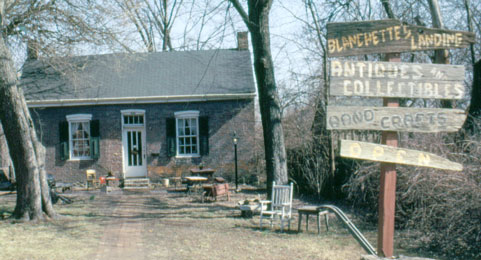
Circa 1793 – The site of the home of the City of Saint Charles’ founder Louis Blanchette who settled here with his wife and children in 1769. Soon after he was appointed Commandant by the Spanish he built three buildings along the small stream nearby. After his death in 1793, the property was owned by Peter Coontz [Koonz] , a German, who added onto Blanchette’s building or built this one with a small primitive mill along Blanchette’s creek.
When Louis Tayon had been appointed Commandant for the District and he felt that all of Blanchettes’ property should by rights be owned by the City and by rights become his under the Spanish Crown. This would later be argued all of the way to Missouri’s Supreme Court, with the Court still finding in favor of the Coontz family. Excavations done by the Archeology Department for Lindenwood University do confirm that there was a building situated here at this location during the time period of Blanchette’s arrival.
For more stories of St. Charles County History subscribe to this blog (its free!)






 ST. CHARLES COUNTY HISTORY
You must be logged in to post a comment.