Two hundred years ago, those living here in the Saint Charles District of the Territory of Louisiana, did not know that our young United States had just officially gone to war for the very first time. Without today’s internet, blogs and tweets, they were totally unaware that the House of Representatives had hotly debated the issue, behind closed doors, ending with the closest vote for war in our Nation’s entire history. For most of the United States, this war would be over the issues of trade embargoes and the impressment, the forced service of over 10,000 of our men into the British Navy. But for those living here on the frontier, it was “The Indian War”, which had started years before. The British used the Indian tribes, inciting them to slaughter, because of our expansionist activities. Britain was involved in a fierce struggle with Napoleon in Europe. Our pride would not allow us to ignore these threats to our national honor, that most viewed as a continuation of our War for Independence.
Here, the war actually began with Jefferson’s purchase of the Louisiana Territory in 1804. Quite a deal had been cut because France needed the money. Saint Charles territory stretched northwest of the Missouri River to uncharted lands. After the Corps departed that May, a trickle of settlement began. We were far outnumbered then by the Indian tribes. The Territory contained nearly the entire domain of the Sauk and Fox. We lived in constant fear of attack.
When Sauk and Fox killed several settlers north of Saint Charles, they turned over one of the warriors involved in the incident, with a petition for pardon to Governor Harrison. The result was a Treaty, in 1804, that read,
“As long as the lands that are now ceded to the U.S. remain their property, the Indians belonging to the said tribes shall enjoy the privilege of hunting on them.” Some even questioned whether the U.S. had the right to Treaty, the paper was so freshly inked. The treaty did NOT sit well with the settlers.
In June of 1805, the Federal government established Fort Bellefontaine, the first American fort west of the Mississippi River. A young man named George Sibley served as the factor’s assistant. John Johnson from Tennessee, an avowed Indian hater, settled his family east of Portage des Sioux, about fifteen miles from Saint Charles. The settlement was growing with families like Boone, Howell and Cooper, mixing with the earlier French and Spanish. Benjamin Cooper, a friend of Daniel Boone would settle first at Hancock’s Bottom, today’s Dutzow, but soon move westward within two miles of Boone’s salt lick, or today’s Arrow Rock. This was all the Territory of Saint Charles and we made the Indians mad with all this settlement. Acting Governor Dr. Joseph Browne gave out Military appointments in 1806 for the District of Saint Charles Militia that created 6 companies.
In 1808 General William Clark, asked for volunteers to accompany him and the Militia, under the command of Eli B. Clemson, to establish a fort and factory, Fort Osage, or Clark as referred to by some. They made 21 miles their first day, and camped near a chain of three small ponds, where Pond Fort would later be built. In September they arrived at what would become the most western point of Military occupation by the U.S. Government and within the Territory of Saint Charles at that time. The site had been chosen by Lewis and Clark years before. Young George Sibley was appointed factor there, and the government hoped to further friendly Indian relations.
There General William Clark began to negotiate a Treaty with the Osage, which would cede nearly 200 square miles of land between the Missouri and Arkansas River to the United States. Soon it was renegotiated, and on November 10th a Treaty negotiated by Auguste Choteau added “all claims to land north of the Missouri River” another 20 million acres, for an overall total of 50 million acres. Clark and Choteau thought with this Treaty would put an end to all of our Indian problems.
But much more would be needed to co-exist with the Native Americans. KaKaGiChe, a Sauk warrior had killed a trader at Portage des Sioux, Antoine Le Page. Two Iowa braves, White Cloud and Mera Naute killed Joseph Thibault and Joseph Marechel. In November, Governor Lewis gave Orders for 370 men to organize, arm and equip for actual service, to be the militia of the Territory of Louisiana. Each officer of that detachment was ordered to furnish himself with a sword, uniform coat and hat; non-commissioned officers were to furnish themselves with a good rifle, tomahawk, scalping knife, horn and pouch, 24 rounds of ammunition, a blanket and a knapsack. All of this created a false sense of peace, while the threat of attack was just a half day’s ride from St. Charles.
Settlement was sparse, and in clusters. Attacks by the Sauk, Fox, Potowatomis and Iowa increased. They stole horses from the settlers and murdered four members of Stephen Cole’s party when they set out to retrieve them. St. Charles was incorporated in 1809, and by1810 the population of the Territory would reach 20,845 with just over 3,500 residing in our District.
George Gatty had settled west of Dardenne Creek, (near the Intersection of Mexico and Jungerman Roads) where he built a home that he quickly turned into a fort to protect his family and neighbors. His neighbor, William Becknell, would first join Daniel Morgan Boone’s company – the U.S. Mounted Rangers. Later, Daniel Morgan’s nephew James Callaway took command of them. Becknell would join Capt.Callaway in Major Zachary Taylor’s campaign on the Sauk Indians, against the British, at the battle of Credit Island. Later Becknell would take command of Fort Clemson (a fort across from today’s Hermann Missouri) built by the Missouri Rangers on their way home from building Fort Osage. Becknell is considered the father of the Sante Fe Trail.
Other settlements were soon “forting up,” such as the home of Isaac Van Bibber, an adopted son of Daniel and Rebecca Boone. The farm of John Pitman, which he’d purchased from George Huffman, and included land previously purchased from the Cottle family, near today’s Cottleville was forted up. Capt. James White settled his family on land west of the Mississippi, east of Peruque Creek, south of the Quivre River, along the Salt River trail, and established White’s Fort. Tiny settlements ranged across the entire Territory. Settlements from Femme Osage to La Charrette to Cote Sans Dessein (near today’s Jefferson City) dotted the Missouri riverbank, and would soon become local “forts”.
The attacks increased. A newspaper report read:
“The family of Mr. Neal was killed in the district of St. Charles on the bank of the Mississippi by a party of unknown Indians; it was believed that the mischief was done by a party of Illinois … I saw the bodies, nine in number, principally females. “ Immediately after… Governor Howard sent orders to Col. Kibby, who commanded the St. Charles Militia to call out the portion of the men he had held in reserve, to march at a moments notice.” These troops were waiting for just such a moment.
On the 3rd of March in1812, Governor Howard acting on his own authority ordered a company of mounted riflemen raised, for 3 months, all from the District of St. Charles to be put under the command of Capt. Nathan Boone. Then he sought authorization for his actions from the President Madison. In May, word came “that a Federal Commission has come for Nathan Boone, as Captain, for a company of Rangers to be raised for 12 months.” Many of those finishing their 3 months of service eagerly rejoined for another 12. George Huffman’s son, Peter, served in Nathan Boone’s Militia, which officially was called the St.Charles Mountain Men. They earned 75c a day when serving on foot, and $1 when mounted. Boone’s log book refers to them as “Minute men.”
Back east, John Clopton, Congressman from Virginia stated:
“The outrages in impressing American seamen exceed all manner of description. Indeed the whole system of aggression now is such that the real question between Great Britain and the U.S. has ceased to be a question merely relating to commerce… it is now clearly, positively, and directly a question of our Independence.”
War was official on June 18, 1812, and some would call it the “Second American Revolution,” here it would simply be our “The Indian War.” Callaway’s Rangers included settlers from Howell’s Prairie, Pond Fort, Femme Osage and the Boone Settlement. Companies were raised by James Musick at Black Walnut, Robert Spencer at Dardenne, John Weldon of Dardenne Prairie, Benjamin Howell out on Howell’s Prairie, and Christopher Clark in Troy.
Governor Howell, advised those settlers with Benjamin Cooper out near Boone’s Lick, to move in closer to the main settlements where they could be afforded some “smallest measure of protection.” Col. Cooper replied:
“We have made our homes here and all we have is here, and it would ruin us to leave now. We be all good Americans, not a Tory or one of his pups among us, and we have 200 men and boys that will fight to the last and have 100 women and girls that will take their places with [them]. Makes a good force. So we can defend the settlement. With God’s help we do so.” And so they did.
Closer to St. Charles the settlers gathered at Griffith’s farm, Johnson’s farm, Portage des Sioux, Royal Domaine, Wood’s Fort, Clark’s, the Peruque settlement, Price’s farmstead, Baldridge’s farmstead, Zumwalt’s Fort, Kountz’s Fort, and waited. Where ever they could, settlers created forts out of their homesteads or erected house forts. Where there were several families, cabins were erected and stockades connected them, with wells dug, protecting their livestock as well.
Further west on the frontier was Journey’s near Warrenton, Kennedy’s near Wright City, Quick’s Fort and Talbott’s Fort were near McKittrick (now Warren County) and Isaac Best’s and McDermott’s were near Big Spring, and Jacob Groom’s near Readsville (today’s Montgomery County) . North, in today’s Lincoln County, was Buffalo Fort near Louisiana, Stout’s Fort near Auburn, Clarksville had a stockade, Fort Independence, and Fort Mason was near today’s Hannibal.
In August, Winnebagos, Ioways, and Ottos joined nearly 100 Sauk Indians with the British above Fort Mason, and stole horses. A company of Rangers and Cavalry commanded by Capt. Alexander McNair were at Fort Mason at the time. With troops commanded by Col. Nathan Boone,together they pursued the thieves that had made their way to an island on the Mississippi near Portage des Sioux, and were about 200 yards out. When Boone and McNair caught up with them, they fled to the Island’s interior. The troop’s horses were too fatigued to swim, but McNair and his Rangers swam over and recaptured the stolen horses, after they had marched 60 miles that day.
In September, 100 Sioux attacked a settler and his wife, stole their horses and cow, which they slaughtered. Captains Musick and Price pursued the attackers in their canoes. There were said to be at least 70 of them. They recaptured the stolen beef. Then in October, the Van Burkleo family was attacked near Black Walnut. A member of the Militia, Van Burkleo would later serve as an interpreter at the Treaty at Portage des Sioux when the War ended.
Those years were filled with danger, and the settlers were constantly being attacked. Men were torn between serving in the Militia and protecting their families. Pleas were made to the Federal government, who the settlers did not believe were doing enough to protect them. Its location made Saint Charles a passageway for all the Indian nations to the north, who had hunted this area for years prior to the arrival of the white man. Settlement was so scattered that communications were difficult. Just as we were the last to know of the beginning of the War, news of the Treaty ending it, at Ghent on Dec. 24, 1814, was just as slow. Too slow, to prevent the horrible incidents that occurred next.
Here on the frontier, Daniel Boone’s grandson James Callaway, had taken command of Nathan Boone’s company of Rangers at Fort Clemson on Loutre Island. They were about to mount another campaign, so Callaway had sent many of his men home to prepare, when the alarm came that Sauk and Fox had stolen several horses. Callaway gathered his men still at the Fort and took out in pursuit westward. They followed their trail up the dry fork of the Loutre, and discovered an abandoned Indian camp, with just their horses and a few Indian women there. They retrieved their horses, and turned towards home, with some believing that to return the same way would take them into a trap. It did. As they forded a creek, they were fired upon and Capt. James Callaway was shot. He and five other lives were lost that day.
In May, atrocities against the settlers continued, despite the events in the East. One of the worst happened when a band attacked the Ramsey family, murdering and scalping the entire family, except a two year old and an infant. The final battle here came on May 24, with the Battle of the Sinkhole, when Black Hawk and a band of Sauk attacked Fort Howard.(near Old Monroe) north of the Cuivre River. An ambush on a group of Rangers led to a prolonged siege in which seven of our Rangers were killed.
Finally, word reached the frontier about the end of the war five months before. President James Madison called for a Treaty to be made with the Indians, and selected Portage des Sioux for the location. He appointed Gov. Wm Clark, Illinois Gov. Ninian Edwards, and Col. Auguste Choteau to handle the affair. With the U.S. showing their strength with Col. John Miller and his Third Infantry, and almost the entire force under Gen. Daniel Bissell stationed at Ft. Bellefontaine in place, the drums began to roll. The tribes began arriving July 1st and negotiations lasted for months, with Black Hawk never signing. But the War of 1812, our Indian War, was finally over.

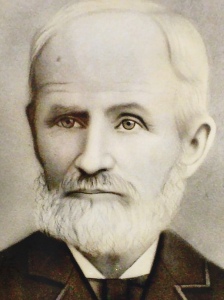 (11 years), myself (Nicholas Krekel) rode in the wagon. Father, my three oldest brothers, Godfred [sic], Arnold and Frank walked. On this overland trip my mother took cold which continued to get worse when coming down the Ohio River, so we landed at Louisville, Kentucky to get medical assistance and religious consolation. She died there on December 14, 1832 and was also buried there. Three years later Arnold went there to find his mother’s grave but the city had been built beyond it. The voyage across the Ocean took 9 weeks, the overland trip from Erie to Pittsburgh took about 3 weeks. After her burial we continued our way to St. Louis. On arriving there we put up at the William Tell house on Main Street, a two story stone building.”
  created in 1818. At least 30,000 German immigrants chose to go west in the 1830s, settling in St. Charles, Warren, Franklin and Gasconade counties. They settled along the Missouri River valley creating the towns of Dutzow, Dortmund and Hamburg. They helped the town of Washington grow and become a German town. They turned The Philadelphia Settlement Society into the German town of Hermann.
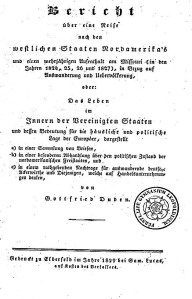 Born in Remscheid in 1789, the young attorney had lived with the farmer Jacob Haun, even though he had purchased a large parcel of land himself. Observing the life of the “American farmer” and describing the life of Missouri’s earliest residents Duden described a place where freedom and opportunity were almost taken for granted, causing some Germans to decry Duden’s description as an impossible fairy tale.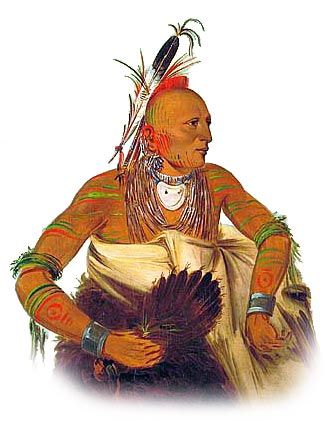




 ST. CHARLES COUNTY HISTORY
You must be logged in to post a comment.