ST. CHARLES COUNTY HISTORY

By Dorris Keeven-Franke

  • Old Maps

    Everyone loves old maps. Maps can do a lot more than give directions. Historic maps can share what a place looked like at a certain point in time and transport us back. There are some maps can do more than all of this, they can share a story as well. This is the story of a map that takes people back in time, to the City of St. Charles historic past, all the way back to its’ beginning.

    It took me back to the City’s beginning. In 2010, when I began working as archivist for the St. Charles County Historical Society, I discovered a crinkled and faded old map. The secretary at that time, Cleta Flynn, was introducing me to some of the more reclusive collections tucked away in corners of the archives and had said “if you like old maps, this large map case has a lot of interesting old ones.”  Buried in amongst several other interesting items, was one that was taped, creased, folded and flattened (something us archivists hate) and that appeared to have not seen daylight in a hundred years – which was good for the map – but also rather sad.

    Keeping the old map handy for the next few years, it would be used for study from time to time by myself, and several of the volunteers.  Trying to unlock its secrets, the map did not appear to have any date on it, nor did it have a signature to recognize who had drawn this treasure trove of information. Realizing it was a map of St. Charles, and that it was old (which could also be recognized by its ink and paper) we became determined to learn more. It was old, but just how old? And who had drawn it? And why? What was its’ purpose and who was the information for? This wasn’t a map for directions.

    The map clearly laid out St. Charles as a grid of streets and cross streets, giving just their names. The street names were old and historic themselves, such as Barbour, Chauncey, Pike and Clay, names that meant something in the early 19th century when St. Charles was just a village. Over the years we would pull the map out whenever a researcher needed information about very early St. Charles. The names of the owners in each of these blocks became very important, as that seemed to be the purpose of the map. It became obvious that if we were to know just when the map was made, perhaps knowing more about when these were the owners, we could possibly discern a date. And so every time we were able, we used the map, taking great care.

    Then one day a local researcher came in working on these families, who had done some very careful research on these early families. Finally we were able to pin the map down to the era of circa 1817-1822, with his help. This is when it became apparent that this was a vital component to our City’s history. Discussing this with our Local Records Field Archivist Bill Glankler and Lisa Fox, at the State Archives was my next step. Evaluating the authenticity, the condition of the map and its importance, was their next step. It was then decided that this should be something submitted to them for conservation and preservation.  Lisa Fox, Head Conservator at the Missouri State Archives, Mike Everman, in St. Louis, and Bill Glankler coordinated everything. Fox’s wonderful team worked their magic, carefully removing the old tape, creases, and even the dirt to reveal a more magical piece of history. The map, approximately fourteen by seventy-two inches was then digitized in order to enable everyone to delve into its history. The State Archives also retained a digital scan of the map thereby enabling everyone access to this historic treasure.

    Because of this great work, the map is carefully preserved, yet made available to everyone. Since then, I wanted to know more of the maps other great mysteries. Who was its’ creator and why? What stories does this map share? That has been quite a journey as well, leading to all kinds of wonderful new discoveries of St. Charles and its history. Sometimes, when trying to discover the stories found in old documents and maps, you have to travel to the time in which the people lived. This map does help one to do that.

    For clues to its’ history one has to look at what information is shared and the purpose. This map provides a) the layout of streets, their names, and measurements; b) names inside some of the blocks formed by that grid; c) the dimensions of the blocks in the old French Foot measurement; and a survey number of that block of land. The names of the streets running north and south and parallel to the Missouri River are Main, Second, High and Fourth. The cross streets (these run east-west) run from Barbour, which is the original southern city limits to Tecumseh Street on the north. The Missouri River is not shown, neither is the Boone’s Lick Road, nor any buildings, landmarks or terrain. This map was probably made by Benjamin Emmons (the first) to start and establish who was where in St. Charles.
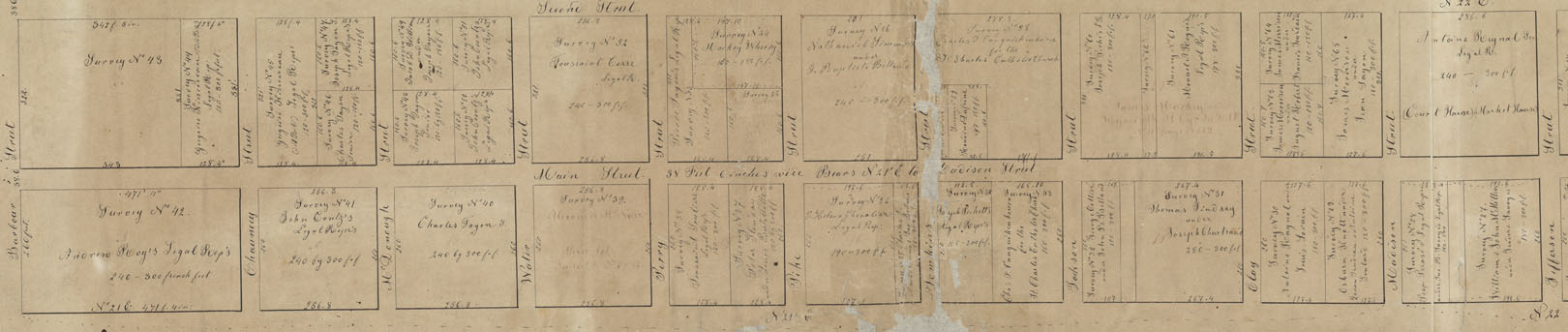
    1817 Survey Map of the Village of St. Charles. St. Charles County Historical Society Archives, 101 S. Main Street, St. Charles Missouri.

    Enter your email for a free subscription to a daily email with St. Charles COUNTY history! Share with your friends… they will thank you for it!

  • Researching the history of a place

    When one buys an old building, or home, they buy history! No matter if it is in a big city or a town, or out in the country, if its old – it has history! After writing the history of the 150 buildings on Saint Charles Main Street I learned there is so much history, yet always more could be found. Research of a place, whether it be a building, a cemetery, a school, a church or where a historic event occurred, there’s a story! Here’s a few of the things I’ve learned over the years on how to learn the history of your place!

    Begin by building your timeline with Deed and list of Owners

    You can start with the legal history of the property. Its like the skeleton, and I’m not talking about ghosts! Its’ the framework of who was the legal owner and when. But not all owners lived on a property, and not all owners are a single person, but sometimes a society or group of trustees, a school board, or even a “benevolent” association. To begin with you have to know the first owner, and each subsequent owner of the property and the dates that they owned it. Most begin as U.S. Land, but could be early Spanish land grants as well. Someone purchased it from either of those and then sold it. Those sales, are Deeds that are recorded at the County Recorder of Deeds. Now if you are lucky enough to have one of those good old fashioned abstracts around, that the deed company provided when the property changed hands, this is great. What you want to create is the same thing, the transfer each time the property changed hands, who it was sold to, what was on the property, and when exactly this happened. This creates a timeline of the property. When buying a property the title company is doing this research but its expensive, and well-worth it. This can take quite a bit of time in the County Recorder of Deeds office. In St. Charles County (MO) one can research the deeds online in St. Charles County at https://stcharles.landrecordsonline.com/index.html at almost any time of day! This is a great advancement through technology. You will want to read the actual deed and make a copy to refer to. These old deeds can tell you a lot whether it was Main Street or a cemetery!

    Its’ the people who tell the “STORIES”!

    Now its’ time to be part genealogist and part “history detective”! Once you have developed your timeline of who owned the property and those dates you will want to know more about the people!! That is the flesh and blood of the story. The lives of the people who lived or died on your property. The stories are not always limited to the “property owner” though! Innkeepers, churches, slave owners, schools, cemeteries are all examples to stories linked to a place and not the owner. Deeds, tax documents and estate probates can tell you more sometimes about the buildings. Plat maps share where schools and graveyards, mills and orchards, creeks and churches are. Sanborn Insurance maps were used by local insurance salesmen to document the buildings make up, roof, doors and windows for the big insurance brokers in the east. Circuit Court records are full of disputes over properties where the mortgages weren’t paid, or siblings fought over who should get what. Newspapers will share the stories of fires, murders, and lynchings! And the stories don’t stop there.

    So many sources

    There are so many sources for this information!!! You can spend forever developing the story of your property just researching the lives of all the people who lived there. You may even want to consider Nomination to the National Register of Historic Places if it qualifies, and it hasn’t already been done. St Charles has several historic districts, that there may have been research done on your building. Check first to see if its listed and if its eligible at https://dnr.mo.gov/shpo/ where there is a great group of people ready to answer questions! Several cities in St Charles County have Historic Preservation Commissions, St Charles, Cottleville, O’Fallon, Wentzville and are always good resources! Get involved.

    Also consider visiting the St Charles County Historical Society, 101 South Main, Wentzville Community Historical Society on Pearce, or Flint Hill Historical Society (online Facebook).

    Below is a list of a few online links that you many find helpful….

    Further steps in developing your place’s history …

    • Death and Taxes are the two things you can’t escape. Those records in St. Charles County (MO) can be found at https://lookups.sccmo.org/assessor where all the public records for property can be found. If its in St. Charles County they’ve got it. You will find the Deeds literally in the Recorder of Deeds office in the new St. Charles County Administration building on Second Street in St. Charles. This date is not to be taken as absolute though.
    • Newspaper articles can be found at either https://www.newspapers.com/ for a cost or many can be found in the archives of the State Historical Society of Missouri in Columbia, where they have microfilmed thousands of newspapers. To find out what newspapers they have see http://shsmo.org/newspaper/ or check out some of the great collections of newspapers at the St. Charles City-County Public Library at the Kathryn Linnemann branch through http://www.youranswerplace.org/ which is also free. What are you looking for? If the owner died a tragic death you will find it in his obituary, or if the house suffered damage in the cyclone of 1876, or maybe he did something famous that put him in the newspaper.
    • If you’re proficient in genealogy and have an Ancestry.com account try searching the families that lived there in the Public Family Trees. If you find your people, contact the owners of that tree. They will love knowing and having pictures of their ancestors house! You will want to connect with earlier families that lived in your house because only they can give you pictures of the Christmas tree in front of the mantle or Grandpa on the front porch. They are a resource like no other! Also consider https://www.familysearch.org/ as a FREE website with the Church of Latter Day Saints behind it. This is a huge database that you can create a free tree and log into thousands of digitized records. There is more to Genealogy than just these sites though!

    Suggested research sources…

    • Sanborn Insurance Maps that show what your house looked like in certain years. University of Missouri has been Missouri’s resource and has them available online…https://dl.mospace.umsystem.edu/mu/islandora/object/mu%3A138690
    • Tax books! Nothing tells a story better than when the value of a property. No one escapes the tax man! The Assessor decides how much the value should be. Just like today, financial crisis and wars do affect these things. The Collector tells you if the taxes. were being paid, by whom and by when!
    • Will and Probate files at SCCHS
    • Plat maps, County Atlases, and Aerials
    • Histories written about the various towns and cities

    There is so much available online

    Share your stories and who knows, someone else may be able to help with more!

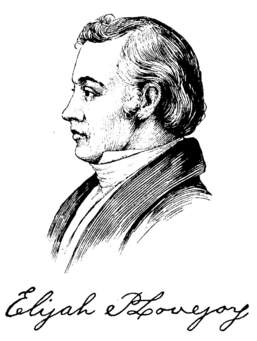
  • Elijah Lovejoy

    “as long as I am an American citizen, and as long as American blood runs in these veins, I shall hold myself at liberty to speak, to write, and to publish, whatever I please on any subject, being amenable to the laws of my country for the same.” Elijah Parish Lovejoy

    I plant myself down on my unquestionable rights, and the question to be decided is, whether I am to be protected in the exercise and enjoyment of those rights,–that is the question, sir,– whether my property shall be protected; whether I shall be suffered to go home to my family at night without being assailed and threatened with tar and feathers, and assassination; whether my afflicted wife, whose life has been in jeopardy fromElijah P Lovejoy continued alarm and excitement, shall, night after night, be driven from a sickbed into the garret to escape the brickbats and violence of the mobs,–that, sir, is the question.[Here the speaker burst into tears.] Forgive me, sir, that I have thus betrayed my weakness. It was allusion to my family that overcame my feelings; not, sir, I assure you, from any fears on my part. I have no personal fears. Not that I feel able to contest the matter with the whole community: I know perfectly well I am not. I know, sir, you can tar and feather me, hang me, or put me in the Mississippi, without the least difficulty. But what then? Where shall I go? I have been made to feel that if I am not safe in Alton I shall not be safe anywhere. I recently visited St. Charles [301 South Main Street, St. Charles, MO] to bring home my family. I was torn from their frantic embrace by a mob. I have been beset day and night in Alton. And now, if I leave here and go elsewhere, violence may overtake me in my retreat, and I have no more claim upon the protection of any other community than I have upon this; and I have concluded, after consultation with my friends and earnestly seeking counsel of God, to remain at Alton, and here insist on protection in the exercise of my rights. If the civil authorities refuse to protect me, I must look to God; and if I die, I am determined to make my grave in Alton.”

    Five days later, Nov. 7, 1837, a citizen mob took him at his word, beset him at his printing-office, and murdered him.

    From the pages of William Greenleaf Eliot’s book “The Story of Archer Alexander“, where he writes “I am indebted for nearly all the details to several recent articles in the “Globe Democrat” of St. Louis, and in the “St. Louis Republican,” the latter of which are from the pen of Mr. Thomas Dimmock, one of the ablest editors of that well-known and influential journal.” who wrote “Mr. Lovejoy first came to St. Louis in 1827, being at the time twenty-five years of age. “Having a decided taste and talent for journalism, he naturally drifted into it, and in 1828 became editor of the long since forgotten ‘Times,’ then advocating the claims of Henry Clay. His editorial work made him quite popular with the Whig party, and might have opened the way to political advancement; but in the winter of 1831-32, during a religious revival, his views of life underwent a radical change, and he united with the Second Presbyterian Church, then in charge of Rev. W. S. Potts. Believing he had a call to the sacred office, he entered the Princeton Theological School in the spring of 1832, where he remained until April, 1833, when he received his ministerial credentials. In the autumn of the same year he returned to St. Louis, then a city of seven thousand inhabitants, and, yielding to the solicitations of many friends, established a weekly religious newspaper, called the ‘Observer,’ the friends furnishing the necessary funds, and the entire management being intrusted to him. The first number appeared Nov. 29, 1833. In the spring of 1834 he publicly announced his anti-slavery principles, and thus began the bitter warfare, which finally cost hirn his life. He was not, however, what was then popularly known as an abolitionist. He favored gradual emancipation, with the consent, compensation, and assistance of the slave-owners; and this should be considered in our estimate of the character and conduct of the man, and of those who hounded him to death.”

    First Post by Dorris Keeven-Franke November 16, 2018