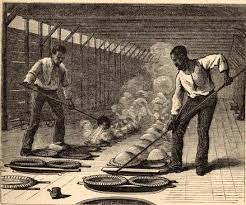
27 August 1829 – Traveled twelve miles to Stockton’s for breakfast, excellent fare. The turnpike ends eight miles from Ganly [Gauley]. A new contract had just been taken by Trimble and Thompson to continue to Charleston, 30 miles at the rate of $1595 per mile, bridges included. Very cheap road. The sixty miles between Charleston and Sandy will be let out on the first of October. We this day passed through the rich narrow bottoms of Kanawha, a great part of which is covered with a heavy crop of corn. Ten miles of the valley are called “the Licks” from their being covered with salt works. There are sixty furnaces which manufacture 2,000,000 bushels of salt annually.* The manufacturing of salt would be much more extensive if it were not entirely monopolized by a company. It will someday be a place of much more importance. The buildings about the salt works are miserable shells and hovels, temporary and unsubstantial. We passed the Burning Springs and came to Charleston about night. Charleston is a town about as large as Lexington, Virginia. It is built on a bottom along the Kanawha River. One street is laid off along the margin of the river, scarcely leaving room for a row of houses between the street and the river; here all the business is done. The other street has but few houses on it. The beauty of the town is very much diminished by the row of houses on the river bank. The houses are principally of wood, some brick.
Written in 1829, this is the journal of William M. Campbell. This is also the story of Archer Alexander, an enslaved man born in Lexington, Virginia, who was taken to Missouri in 1829. There are 38 entries in Campbell’s journal, which begins on August 20, 1829 that you can read and follow the story of Archer Alexander. Campbell’s journal is located in the Archives at Washington and Lee University in Lexington, Virginia and is being shared here so that we may hear all the voices, including those whose voices were not shared originally. The photos were taken by me when visiting Virginia for research and then following the pathway that Campbell shares in his journal. Please keep in mind the context of the time in which this journal was written. Feel free to share your comments directly on this blog or join in on the discussion in the St. Charles County History Facebook Group. You may sign up for email alerts of the daily blog posts below.

*The Kanawha salt furnaces were labor intensive. The salt makers employed many slaves, making Kanawha County an exception to the fact that Western Virginia had relatively few slaves. By 1850, there were as many as 1,500 slaves at the salt works, owned by the salt barons or leased from other owners. See https://www.wvgazettemail.com/life/historian-shines-light-on-regions-forgotten-history-of-slaves-owners/article_a5dcfb35-fd5f-50c7-9b06-51f456cde046.html
 ST. CHARLES COUNTY HISTORY
You must be logged in to post a comment.