
Edward Bates was born in 1793, in Goochland County, Virginia. In 1814, he would follow his brother Frederick, who had been appointed by President Thomas Jefferson as Secretary of the Louisiana Territory. Edward studied law under Rufus Easton, the Territory’s Chief Clerk, and then serving on the Supreme Court, he would receive his bar degree in 1816. In 1820, he would serve in the State Convention , after being one opposed to the restriction of slavery. In 1822, he would serve Missouri in the House of Representatives, located in the village of St. Charles.
Edward Bates’ brother Fredrick Bates would serve as Missouri’s second Governor, where he would die while he was in office in 1825. The first State Capitol would move from St. Charles to Jefferson City in November of 1826. Edward Bates would establish his home on the Boone’s Lick Road (Today’s Highway N) in Dardenne Prairie in 1829, naming his huge plantation of 500 acres Walnut Grove. There he built a 22-room mansion, the largest in St. Charles County and name it Chenaux. The huge home was flanked by two large twin Chimneys. (The home is no longer standing.)
In 1844, Edward Bates would serve as the pro-bono attorney for Lucy Berry, later known as Lucy Delaney, author of the 1892 slave narrative “From the Darkness cometh the Light”. Her case, which Bates won, served as the inspiration for the freedom suit of Harriet and Dred Scott. “Despite his efforts on behalf of freepersons like Lucy, Bates had reservations against exerting greater pressure on slavery itself. Personally, his actions regarding enslaved people were in line with his contemporaries who exhibited no personal qualms with treating Black people unequally. At times, Bates hired out his enslaved servants to his neighbors. At others, he profited from their sale.” [i]
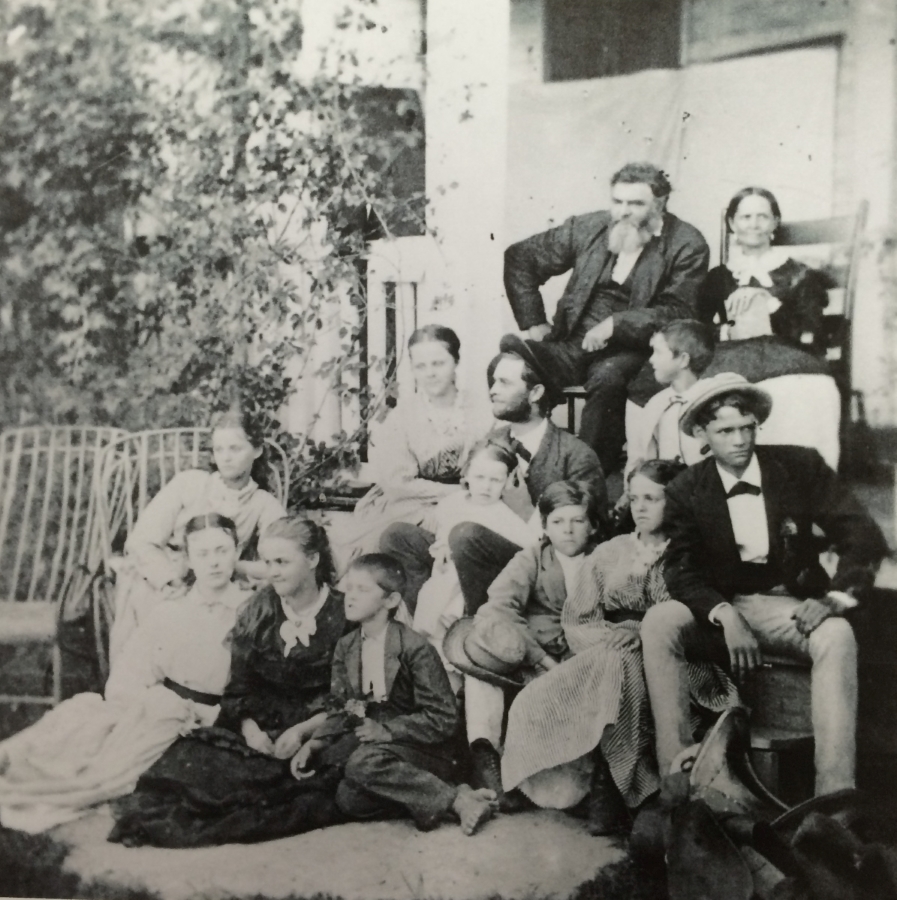
During the Civil War, Edward Bates would serve in President Abraham Lincoln’s Cabinet as the United States Attorney General from 1861until 1865. When Edward Bates retired and returned to Missouri, his son Joshua Barton Bates was living at the family’s estate in Dardenne Prairie and raising his family. President Lincoln had appointed Barton Bates as a Missouri Supreme Court Judge in 1862.
From the Twin Chimneys Elementary which was built in 1993: Most of the Winghaven Development is located on what was the Bates’ property. Even now, if you superimpose the 1800’s property map over present day satellite images, they are still eerily similar. The part of the Twin Chimneys subdivision, Little Oaks, is where the original residence, Cheneaux stood. In our Twin Chimneys Elementary community, there are still signs of Judge Bates and his family. Many streets in the adjacent subdivision are named after the Bates family. Bates road of course, Onward Way for the Judge’s oldest son, Thornhill was the name of the residence owned by an uncle, and Watson’s Parish was named after the Reverend Thomas Watson of Dardenne Church.
Endnote
[i] Neels, Mark A, Lincoln’s Conservative Advisor, Southern Illinois Press, 2024
SUBSCRIBE AND RECEIVE A FREE DAILY DOSE OF ST. CHARLES COUNTY HISTORY IN YOUR EMAIL
 ST. CHARLES COUNTY HISTORY
You must be logged in to post a comment.