Tuesday, May 22, 1804 Journal entry of William Clark
a Cloudy morning Delay one hour for 4 french men who got liberty to return to arrange Some business they had forgotten in Town, at 6 oClock we proceeded on, passed Several Small farms on the bank, and a large creek on the Lbd. Side Called Bonom [Bonhomme-A Good Man- French] a Camp of Kickapoos on the St. Side Those Indians told me Several days ago that they would Come on & hunt and by the time I got to their Camp they would have Some Provisions for us, we Camped in a Bend 〈under〉 at the Mo: of a Small creek, Soon after we came too the Indians arrived with 4 Deer as a Present, for which we gave them two qts. of whiskey—
Course & Distance th 22d May
| S 60° W. | 3 | ms. to a pt. Lbd Side |
| S 43° W. | 4 | ms. to a pt. on Stbd. Side |
| West | 3 ½ | ms. to a pt. on Stbd Sd. psd Bonon |
| S 75° W. | 7 ½ | ms. to a pt. in Bend to Stbd Side at the mo. of Osage Womans R |
| 18 |
This Day we passed Several Islands, and Some high lands on the Starboard Side, Verry hard water.
HOWELL’S FERRY
What was called Bonhomme in Clark’s journal is today the Wildwood/Chesterfield Bottoms, originally the site of towns called Bellefontaine, Gumbo and Centaur. Also, on the south side of the river is the plantation of Frederick Bates (1777-1825) Missouri’s Second Governor. He would use the Ferry to cross the Missouri River, which is the location of the Interstate 40/64 Bridge/Daniel Boone Bridge. On the north side of the river lay the plantation of Thomas Howell. Frederick Bates was Governor when St. Charles was Missouri’s First State Capitol, and died while in office.
Howell’s Ferry can be first found in records in 1804, and the journals of Captains Meriwether Lewis [1774-1809] and William Clark [1770-1838] as they embarked with their Corps of Engineers and enslaved man York. As the Company began their westward journey on May 22, 1804, several journals refer to their passing on what is called Bonhomme Creek on the south side of the Missouri River.[i] This was their first stop as they began their journey south of the village of St. Charles. This was also near the early Spanish settlement known as St. Andre, where the Spanish Commandant James Mackay oversaw the Spanish District up until 1804. Thomas Howell [1783-1869] was the son of a Francis Howell [1762-1834] who
“had emigrated to what is now the State of Missouri in 1797. He first settled thirty miles west of St. Louis, in (now) St. Louis county, where he lived three years, and then removed to (now) St. Charles county, and settled on what has since been known as Howell’s Prairie”[ii].
He had married Susannah Callaway [1791-1876] who was a sister of Capt. James Callaway [1783-1815], a grandson of Daniel Boone. Captain Callaway’s wife was Nancy Howell, a sister of Thomas.[iii] The Howells were one of many families that settled in St. Charles County at that time, following the migration of Daniel Boone’s family from Kentucky. Each of these families owned a large amount of those enslaved as well. In 1860, Thomas Hawel [sic] maintained a plantation that housed 20 enslaved individuals. Four of these men were between the ages of 20 and 35 years old.[iv]

The Hawls [sic] Howell’s Ferry Crossing was an often used route of the Underground Railroad, a network used by freedom seekers, during the Civil War. Today, the African American community known as Westland is here.
NOTES
[i] Journals of the Lewis and Clark Expedition https://lewisandclarkjournals.unl.edu/item/lc.jrn.1804-05-22
[ii] Wildwood Historical Society Files retrieved June 2025.
[iii] Ancestry, Family Histories of Boone, Howell and Callaway families.
[iv] 1860 U.S. Federal Census Slave Schedules, National Archives Records Administration (Ancestry) for Missouri/St. Charles/Dardenne Filmstrip image 4.
This is the location of one of the oldest Presbyterian churches in the St. Louis area. The Reverend Salmon Giddings founded the Bonhomme Presbyterian Church in October 1816. It was the second Presbyterian church he founded in the Missouri territory. In 1841, the congregation built a stone church on Conway Road. The second church he established was in St. Charles.
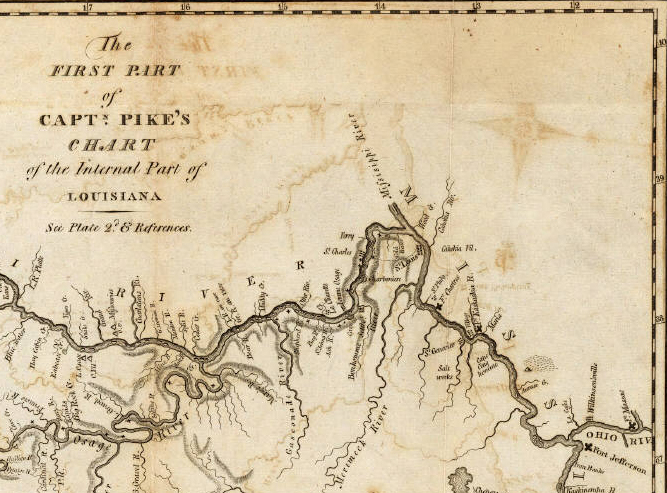
General Zebulon Pike departed St. Charles Main Street from the Morrison Trading Post in 1806.

 ST. CHARLES COUNTY HISTORY
You must be logged in to post a comment.