“The Underground Railroad is one of the most remarkable stories in American history. This is a story of ordinary men and women coming together in harmony, united to pursue the extraordinary mission of helping those in their journey to freedom. This movement, which thrived from the late 18th century through the Civil War, was a testament to the power of unity, courage, and a shared commitment to liberty.”
Stories of the Underground Railroad in St. Charles County have been shared for years. I know of several sites that have oral history associating them with being “stops” or “stations” on the Underground Railroad. The National Park Services’ National Underground Railroad Network to Freedom is the only Nationally recognized program that not only recognizes but documents and shares true stories that would never be known otherwise. There are over 800 sites, stories and programs listed across our country, and there are two sites and one program in St. Charles County Missouri. Th National Park Service began the Network to Freedom in 1998, and while similar to the National Register of Historic Places, requires even more extensive and documentation in order to be listed.
As their website informs readers:
The Underground Railroad—the resistance to enslavement through escape and flight, through the end of the Civil War—refers to the efforts of enslaved African Americans to gain their freedom by escaping bondage. Wherever slavery existed, there were efforts to escape. At first to maroon communities in remote or rugged terrain on the edge of settled areas and eventually across state and international borders. These acts of self-emancipation labeled slaves as “fugitives,” “escapees,” or “runaways,” but in retrospect “freedom seeker” is a more accurate description. Many freedom seekers began their journey unaided and many completed their self-emancipation without assistance, but each subsequent decade in which slavery was legal in the United States, there was an increase in active efforts to assist escape.
The decision to assist a freedom seeker may have been spontaneous. However, in some places, especially after the Fugitive Slave Act of 1850, the Underground Railroad was deliberate and organized. Despite the illegality of their actions, people of all races, class and genders participated in this widespread form of civil disobedience. Freedom seekers went in many directions – Canada, Mexico, Spanish Florida, Indian territory, the West, Caribbean islands and Europe.
In Foristell, Missouri, as you go north from the Interstate 70 exit, you will pass a small entrance to the Historic Smith Chapel Cemetery, where three freedom seekers lie. Established in 1871 the cemetery is final resting place for Smith Ball (1833-1912), Benjamin Oglesby (1825-1901), and Martin Boyd (1826-1912) who each took steps toward freedom and joined the United States Colored Troops, despite the risks involved for themselves and their families. The small one acre of ground was purchased by nine trustees of the Smith Chapel A.M.E. Church where they built a chapel, and laid out a burying ground for their loved ones. They also built a small one room school, that they named Douglass for the great orator, and by 1880 were educating their children, grandchildren and other area black children. All that remains today is the cemetery, but this has earned it a designation as a site on the National Underground Railroad Network to Freedom. For more about the Smith Chapel Cemetery see https://smithchapelcemetery.com/

That schoolhouse which had been replaced in the early 1900s, had fallen into disrepair after desegregation in the 1960s when black children began attending area public schools. It was also during that same time period that families would begin joining the nearby Wesley A.M.E. Church in Wright City or the Grant Chapel A.M.E. in nearby Wentzville. In 2023, the schoolhouse was donated to the St. Charles County Parks and was dismantled and used in creating a replica in the Oglesby Park on Meyer Road in Wentzville. Today it sits at the rear of the park, on the same land that was once owned and farmed by freedom seeker Benjamin Oglesby, which has earned the recognition of the Oglesby Park as a site on the National Underground Railroad Network to Freedom.
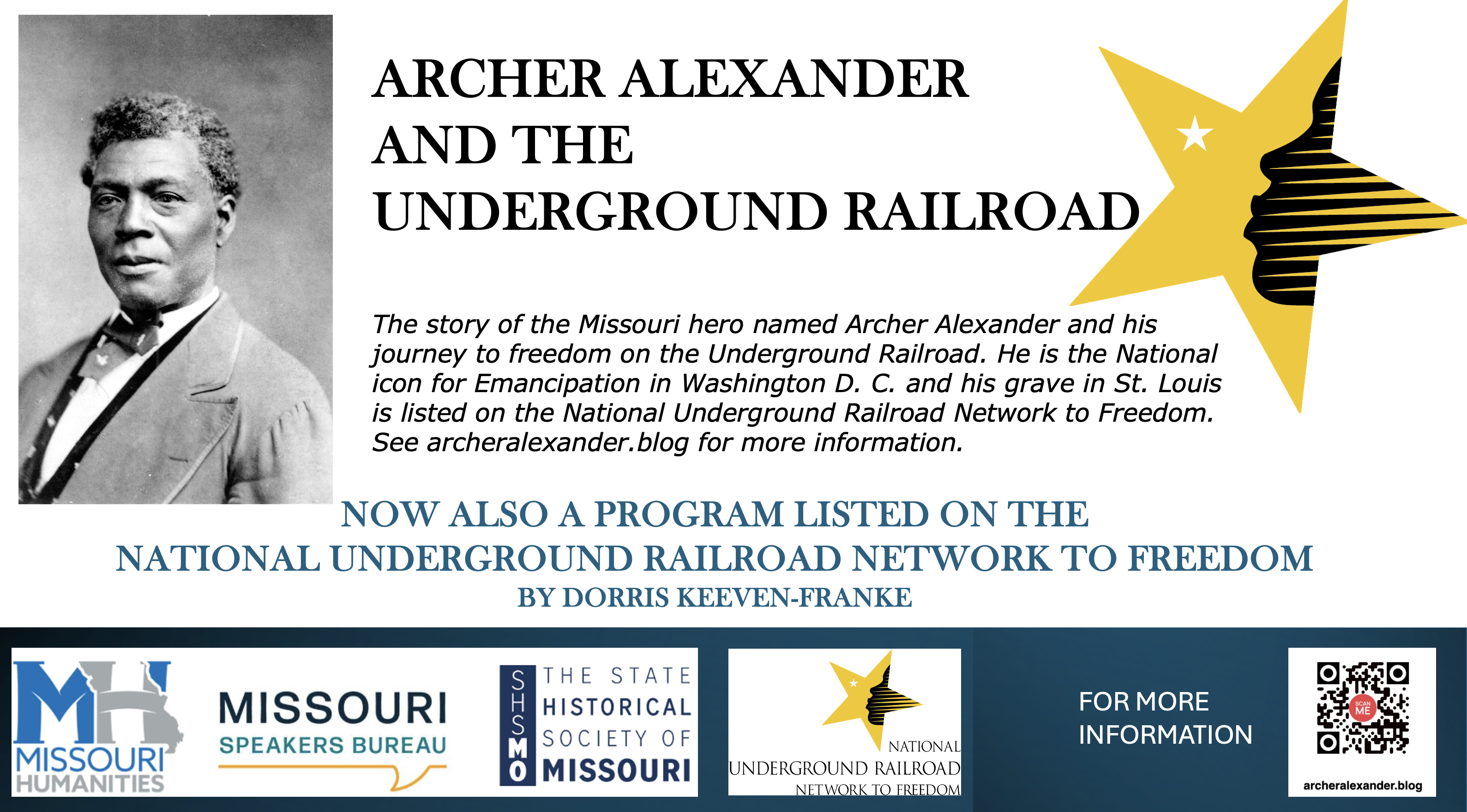
Also listed on the National Underground Railroad Network to Freedom as a PROGRAM is Archer Alexander and the Underground Railroad, a freedom seeker who during the Civil War risked his life to warn the Union Army how the Confederates were about to destroy the Peruque Creek Bridge. Soon after he had to flee, but was joined by sixteen other men that he led across the Howell’s Ferry Crossing on the Missouri River. Archer would be rewarded with his freedom on September 24, 1863 for his services to the military, and he would become the icon for emancipation by becoming the enslaved man on the Emancipation Memorial in Washington, D.C.
For more information about National Underground Railroad Network to Freedom see https://www.nps.gov/subjects/undergroundrailroad/index.htm
TO SUBSCRIBE TO THIS FREE BLOG – STCHARLESCOUNTYHISTORY.ORG
 ST. CHARLES COUNTY HISTORY
You must be logged in to post a comment.