By 1821, Missouri had become a State, and St. Charles County had established “Dardenne” as a Township. As settlers established themselves along the Boone’s Lick Road, there were no “official” towns, but your Post Office was your address. Mail was sent there, and you visited the Postmaster to pay for and retrieve your mail. If not picked up, then your name was listed in the local newspaper letting you know that you need to make a trip to “town” which was usually the mill or General Store as well. Many towns were first established by what the name of the Post Office – quite often his name – or the Railroad Station. Railroads did not begin until 1850s, and the Station Master was automatically the designated Postmaster as well. The word Dardenne is said to be French in origin and given to both the prairie and the creek, but there is no translation for its meaning. Some say a man by that name first lived there, but that too is lost in history. When Census takers would visit, up until 1980 they simply listed the Township as there was not an actual town incorporated by that name until 1983 or a City until 2001. Today it is one of the fastest growing areas in our county, having a population of 13,803 in 2023.

Further west along the Boone’s Lick Road, past Alexander’s or Captain Campbell’s house, we would have found the mill of John Gill, who came from Kentucky to Missouri in 1811. He originally worked as a carpenter, in St. Louis, before returning to Kentucky and marrying there. He returned to Missouri and established a home, tavern and a large Grist Mill on the Boone’s Lick Road by 1822. Soon had established two large farms, which he managed with his sons and enslaved. At the outbreak of the Civil War, he gave each of his sons an enslaved man. As the only mill in the area, he was quite prosperous, and popular. *[1]
Gill House and the Mill’s Millstones were located on the south side of Highway N, 0.6 miles west of Highway K. The mill stones were first purchased from the Dickherber family for marking the Boone’s Lick Road in 1913. At some point the stones were removed and stored at the Howell school. Then Mr. and Mrs. N.H. Loeffler purchased them, and on Septemer 24, 1959, and they were placed on the property and dedicated. Then in about 2012, during the Highway 364 road construction they were once again removed. They were the only mill stones used by the DAR along the entire route. The DAR marker for the Gill Mill is no longer found on the Boone’s Lick Road.

Naylor Store. [7767 Highway N, O’Fallon, MO 63368, USA no longer standing]
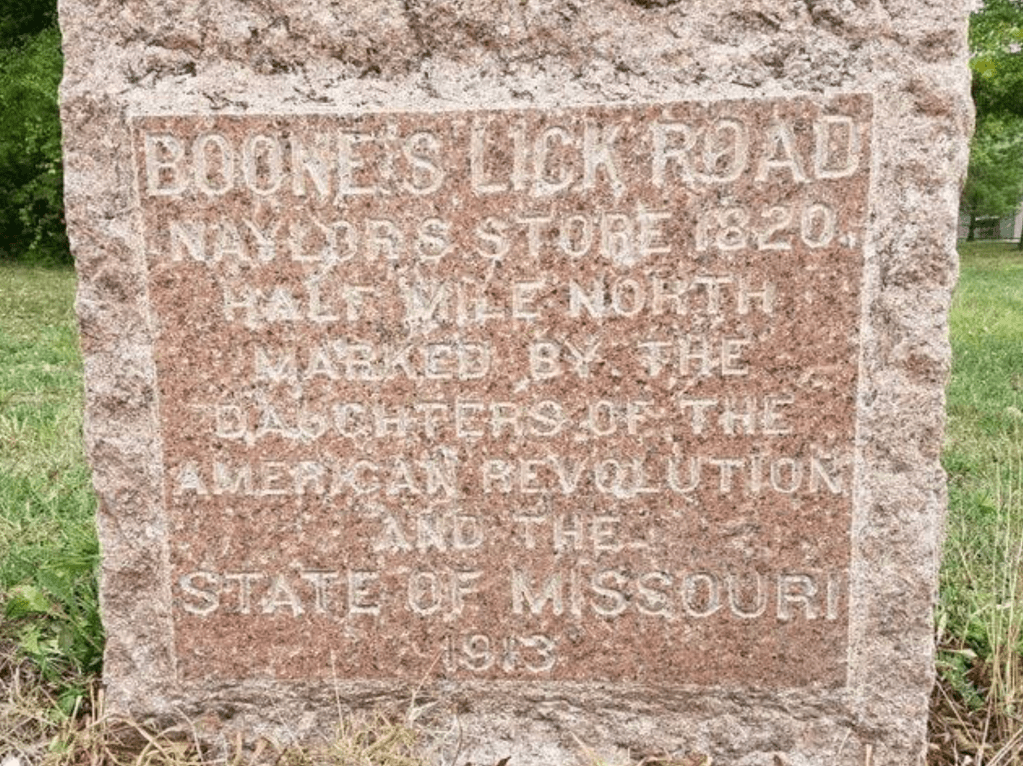
Just past Gill’s mill was the house of John Naylor, where the Dardenne Presbyterian Church first met in 1819. It soon became a Stagecoach and Postal stop, in his Mercantile. Today it is the location of the City of Dardenne Prairie. The road originally curved off to the north to the store, before returning to Hwy N, up until the 1860s. The Dardenne Presbyterian Church’s first church building was first located on the south side of Dardenne Creek (in what is today’s Weldon Spring Government Reserve) but was burned during the Civil War. The beautiful new stone Church that was built after the Civil War can still be seen today as Hwy N, mixes with and crosses Interstate 364.
Naylor’s Store, on the Dardenne Prairie, was a stage stop in the 1820’s. John Naylor was an influential citizen in the area who helped to found the town of Dardenne. He and his wife helped start the Dardenne Presbyterian Church in 1818. The marker is located on the north side of Highway N, 3.2 miles west of Highways K and N intersection.
In David P. Sapp’s Mapping the Boone’s Lick Road he explains the route of the road was documented in early gazetteers, explaining how two contemporary gazetteers and a journal are of major importance in identifying this route.
“John Melish published the route and distances from St. Charles to Franklin in his The Traveller’s Directory Through the United States[i]: . . . in 1822. In this publication, Melish listed hundreds of routes between various cities and towns in the United States, including the road from St. Charles to Franklin. While this work was published in 1822, analysis shows that the effective date was probably 1820. Melish describes the route from St. Charles to Franklin thus: Beginning at St. Charles; 12 miles to Dardenne; 8 miles to Pond Fort; … His total mileage from St. Charles to Franklin is 151. Another great contemporary description of the alpha route comes from Lewis Beck’s 1823 Gazetteer which listed the stage route from St. Louis to Fort Osage. Peters concludes that the effective date of this route is 1821 or 1822, just a year or two later than the Melish data. With Beck, we begin at St. Charles; then 9 miles to Coonts; 12 miles to Pond Fort;”
Postal records shows that the route included Naylor’s Store from 1827-1840 and 1841-1868. This is the same location of Campbell’s 1873 Atlas of New Missouri for Dalhoff Post Office, on land purchased by John Naylor in Section 2, of Township 46, Range Two East.
NOTES
[i] Melish, John. The Traveller’s Directory Through the United States: . . . John Melish: Philadelphia, 1822. 3 Peters, “Path of Land-Rush Traffic Across Boone and Callaway Counties,” Genealogical Society of Central Missouri Reporter Quarterly, vol. 13, no. 2 (Summer, 1994): 39. 4
Subscribe to the St. Charles County History Blog by Dorris Keeven-Franke -its free.
For more about the Boone’s Lick Road – see https://booneslickroad.org/
 ST. CHARLES COUNTY HISTORY
You must be logged in to post a comment.