
An early undated map in the St. Charles County Historical Society shows that In Lynn Morrow’s Boone’s Lick in Western Expansion: James Mackay, the Boones, and the Morrisons[i] today’s St. Charles County is part of the St. Charles District or county, “the only American political subdivision on the north side of the Missouri River until 1816”.
Unfolding events brought Morgan and Nathan Boone into a commercial salt industry with Philadelphia’s Bryan and Morrison trading company, the most influential American firm in Missouri’s trans-Mississippi West. Of the six Morrison brothers who came West, William, the eldest, administered the family business from Kaskaskia, assigning James, Jesse, nephews, and others to implement their strategic economic reach. Boone’s Lick salt became crucial in the Osage Indian trade, Missouri River commerce, and for support of federal and Missouri militia troops in the War of 1812.[ii] It would be James Morrison who would open the Trading Post on Main Street in 1804 that would sell the product of his salt lick in what is later called “the Boonslick” in Howard County. In 1806 he would supply and outfit Gen. Zebulon Pike (Pike’s Peak) expedition from this storefront.
An early undated map of St. Charles I discovered in 2011in the St.Charles County Historical Society archives gives us a view of the village’s Rue de Grande or Main Street in what is believed to be 1817. When the map was restored and processed by Lisa Fox at the State Archives in 2013, this was confirmed in their examination of the paper and ink used, and by Lynn Morrow, with the Missouri State Archives who had examined the map before retiring that year. It places the Bryan and Morrison trading company between Clay and Madison; Main and Second, with other records indicating that the property had been purchased by Morrison by 1804.
Operators of frontier salines usually owned enslaved and/or leased enslaved to shoulder a lot of the hard, physical work, especially wood chopping, but there are few documents about slaves at Boone’s Lick. In 1814, a Draper informant told about Moses, who in the face of an Indian alarm, rode one of the Morrison horses back to St. Charles. Flanders Callaway’s slave Moses had worked for years up and down the Missouri River, serving the Callaway family in agriculture and market hunting. Moses cut a lot of wood at Boone’s Lick, too.
Across from the Bryan and Morrison Trading Company at 200 South Main Street is Missouri’s First State Capitol.

Circa 1819 – Built by Charles and Ruloff Peck in 1819, this building housed Missouri’s first State Capitol from 1821 until 1826. Missouri’s first legislators – some of them frontiersmen and others of the gentry – met in this building to undertake the task of reorganizing Missouri’s early territorial government into a progressive state system. Before Missouri was granted statehood on Aug. 10, 1821, the territorial government met at various locations in St. Louis. As statehood became a certainty, the search began for a site to become the permanent seat of government. An undeveloped tract of land located in the center of the state overlooking the Missouri River was chosen to be the site of “The City of Jefferson,” Missouri’s permanent capital. However, until the new Capitol could be constructed, the state’s first legislators needed a place to meet. Nine cities competed for the honor of hosting the state’s temporary seat of government. One of these cities was St. Charles, a growing center of trade located on the Missouri River with easy access to the most rapidly growing areas in the state via the river or the Boonslick Road. The citizens of St. Charles pledged that if their city was chosen as the temporary capital, they would furnish free meeting space for the legislators. On Nov. 25, 1820, Gov. Alexander McNair signed a bill making St. Charles the first capital of Missouri. The state’s first legislators met in St. Charles for the first time on June 4, 1821. Heated debates over state’s rights and slavery filled the rooms of the new temporary Capitol. The meeting place provided by the citizens of St. Charles was on the second floor of two newly constructed adjoining Federal-style brick buildings. The Peck brothers, Charles and Ruluff, owned one of the buildings and they operated a general store on the first floor. Chauncy Shepard owned the adjoining building with a carpenter shop on the first floor. The second floor of the building was divided and used as Senate and House chambers, an office for the governor, and a small committee room. Four Missouri governors ran the state’s affairs from the Capitol in St. Charles until the new Capitol in Jefferson City was ready in 1826.[iii]
As one continues south on the City of St. Charles Main Street they will pass:

515 S Main St, Saint Charles, Missouri, 63301
Circa 1821 – Historians confer that this is the site of William Eckert’s St. Charles Hotel in 1821. He and his partners had offered his establishment to the State when they were seeking a site for the Capitol , as a larger and more commodious building. At that time, in 1821, a large stone building was known to have sat to the rear of this building, so perhaps that was the one being offered for the State’s use. Some historians suggest that this building was damaged in the 1876 tornado to such an extent that it was altered to be the building you see today. Eckert’s Tavern was also reported to be where Benjamin Reeves, George C. Sibley and Thomas Mathers, who were appointed as Commissioners in 1825 by President John Quincy Adams, laid out the Sante Fe Trail. This work to establish a route for trade with the southwest and New Mexico, went over budget and took seven years for the three commissioners to receive their pay for this feat. [iv]
Further south on St. Charles’ Main Street, one encounters other vestiges of Bryan and Morrison’s route to their salt lick. Farmer’s Home is an example of the many inns and mercantiles that line the street…
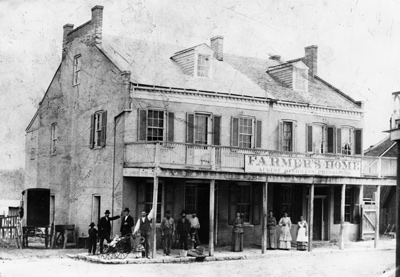
700 S Main St, Saint Charles, Missouri, 63301
Circa 1805 – In 1817 when Alexander McNair owned this property, he would add on to the earliest portion of the building, keeping the French influence. McNair’s wife was Margarite Regal, the daughter of a French Marquis. In 1820, he defeated William Clark, to become our State’s first Governor. Although he lived in St. Louis with his wife and children, he would stay here when he needed to conduct State business. The building was a tavern, where J.J Dozier the Innkeeper would invite the Legislature and other visitors to the town to stay at the establishment when St. Charles was Missouri’s first State Capitol 1821-1826. At that time the cost of lodging was “2 bits a night (or 25 cents) and you could get Chicken Fixings for 3 bits or 37 and one-half cents”. McNair died on March 18, 1824 while still in office. The building would continue to serve as an Inn, and was always a hub of activity, since visitors would arrive on the nearby ferry and have to pass the Inn on their way to the State Capitol, ensuring its success. At one time the inn was known as the “Bear Sign” and owned by a German named Valentine Schmidt. In 1853 the name according to the St. Charles newspaper named the Reville, was changed to Farmer’s Home and managed by the German innkeeper named Frances Bierbaum. On the 26th of February 1876, the Inn was struck by the great tornado. Stories tell of a man in his bed on the second floor who was picked up and thrown into the street without even being hurt. [v]
When you proceed further south, one will reach the location of Blanchette’s first settlement…

906 S Main St, Saint Charles, Missouri, 63301 (private home)
Circa 1793 – The site of the home of the City of Saint Charles’ founder Louis Blanchette who settled here with his wife and children in 1769. Soon after he was appointed Commandant by the Spanish he built three buildings along the small stream nearby. After his death in 1793, the property was owned by Peter Coontz [Koonz/Kountz], a German, who either added onto Blanchette’s building or built this one with a small primitive mill along Blanchette’s creek. When Louis Tayon had been appointed Commandant for the District and he felt that all of Blanchette’s’ property should by rights be owned by the City and by rights become his under the Spanish Crown. This would later be argued all of the way to Missouri’s Supreme Court, with the Court still finding in favor of the Coontz family. Excavations done by the Archeology Department for Lindenwood University do confirm that there was a building situated here at this location during the time period of Blanchette’s arrival.[vi]
Author Dan Rothwell’s book shares how the original pathway of the Boone’s Lick Road merged with Main Street at this point, which was probably because of early connection with Blanchette as Commandant. Early deeds refer to the southern stretch of Main Street as Upper San Carlos as it was where the seat of Government was prior to the Louisiana Purchase.[vii] But by 1851, one had to continue further south on Main Street before it turned west. There one sees further evidence of what the Boone’s Lick Road meant to travelers at The Western House…

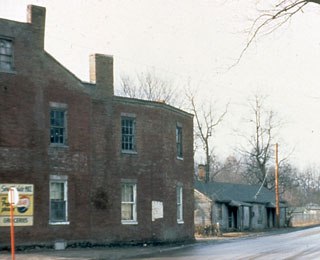
1001 S Main St, Saint Charles, Missouri, 63301
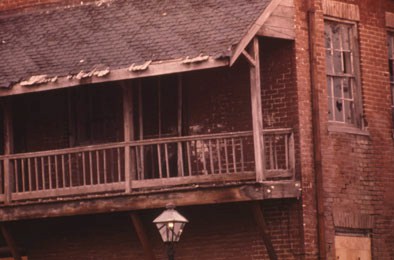
Circa 1820 – Gregorie Kiercereau, born Bebi, was the owner of this property in 1817, and the property across the street to the north indicating that he most likely owned this property prior to that date. Kiercereau was the nephew of the second Commandant Carlos Tayon by marriage. The original structure of the building faces Main Street was built in 1820 with several additions made over the years, with some as late as 1856. During the 1850s, the route of the Boone’s Lick Road, which had begun by the 1820s and had originally left Main Street going west up McDonough, was moved alongside this building. This accounts for the direction of the additions at the rear. The road had been part of the Plank Road system, which was a short-lived paving system which used cut logs forming what was also called a ‘courderoy’. Travelers would often use the logs as firewood though. The city macadamized the road in the 1850s, which is an early gravel and oil method. By that time, Fanny Smith Eckert maintained an inn named Western House here, which was very popular with travelers. An inn was always maintained on the lower floor with sleeping rooms on the upper levels. During the days of the covered wagon treks, a large stable and wagon yard was located in the rear and to the south of the existing building. Later the establishment was conducted by a Mr. Bliss and was considered too rowdy for women and children. The inn provided excellent care to oxen, horses and cattle when Mr. Bliss eventually added a blacksmith shop to provide for care and repair of equipment.




[i] Lynn Morrow, Boone’s Lick Heritage Collector’s Edition Boonslick Historical Society Periodical
Vol. 13 Nos. 3 & 4 — Fall–Winter 2014
[ii] Lynn Morrow, Boone’s Lick Heritage Collector’s Edition Boonslick Historical Society Periodical
Vol. 13 Nos. 3 & 4 — Fall–Winter 2014
[iii] Dorris Keeven-Franke, Historic Main Street Tour ArcGis Map URL: https://arcg.is/1qqHzn0
[iv] Dorris Keeven-Franke, Historic Main Street Tour ArcGis Map URL: https://arcg.is/1qqHzn0
[v] Dorris Keeven-Franke, Historic Main Street Tour ArcGis Map URL: https://arcg.is/1qqHzn0
[vi] Dorris Keeven-Franke, Historic Main Street Tour ArcGis Map URL: https://arcg.is/1qqHzn0
[vii] Dan A. Rothwell, Along the Boone’s Lick Road, 1999, Reprint 2022, Page 22
[viii] Dorris Keeven-Franke, Historic Main Street Tour ArcGis Map URL: https://arcg.is/1qqHzn0orses and cattle when Mr. Bliss eventually added a blacksmith shop to provide for care and repair of equipment.
Subscribe to stcharlescountyhistory.org for a free story by email every day…
 ST. CHARLES COUNTY HISTORY
You must be logged in to post a comment.